
When an individual has a problem with their voice, how do we determine the specific problem and its cause? By setting all parameters constant and varying only one at a time, we find the impairment efficiently — often before ever looking at the vocal cords.
Hearing the Voice Problem
Generally, the patient doesn’t even need to speak words during an examination assessing a vocal problem. Singing is far more fruitful for finding a vocal problem than speaking. If the examiner can listen to a sound at various volumes and various pitches, a vocal impairment will be more easily elicited.
Robert Bastian has described this process as vocal capabilities testing. By modifying one parameter at a time, when we hear the problem, we will know quite likely where the problem lies, even before we look at the vocal cords. Then when we look, we will not be distracted by the color of the vocal cords. We will go straight to where the problem should be and find it.
During all of these tests, the examiner is really an audio engineer, searching for any increase in noise. An excellent voice has a high signal-to-noise ratio — a lot of clarity and minimal, unwanted, non-harmonic sound.
The Vowel /i/
There are some advantages to using the vowel sound “ee” for a vocal exam — in phonetic English, /i/ as in the word feel or bead. This vowel utilizes the most upright position of the larynx and most open position of the pharynx or throat above the voice box. It makes examination of the vocal cords with an endoscope easier. The /u/ sound is a close second, as in who or boo. The other vowels tend to move the tongue and epiglottis back, narrowing the throat and making visualization of the vocal cords more difficult.
I pick one vowel and generally stick with it during my exam, so there is one less variable to deal with. Then I put the voice through a series of tests with this vowel.
A familiar analogy comes from cardiology. A person complains of chest pain and an EKG test is performed. If the result appears normal, the cardiologist continues with a stress test, having the patient run on a treadmill. Now the EKG appears abnormal in association with the elicited pain. Many more problems will be found by stressing the system — whether it is the heart pumping blood or the vocal cords making sound. Most patients, and especially performers with a vocal problem, do everything they can to avoid sounding “bad” in the doctor’s office. It is up to the examiner to stress test the voice.
Recording the Vocal Exam
I record the patient’s voice by putting on a headset microphone held out in front of the mouth. A headset keeps distance from the mouth relatively constant during an examination and between examinations. An audio recording of vocal capabilities documents the vocal functional status of the larynx, including the motor nerves, muscles and mucosal covering of the vocal cords, and outlines vocal limitations.
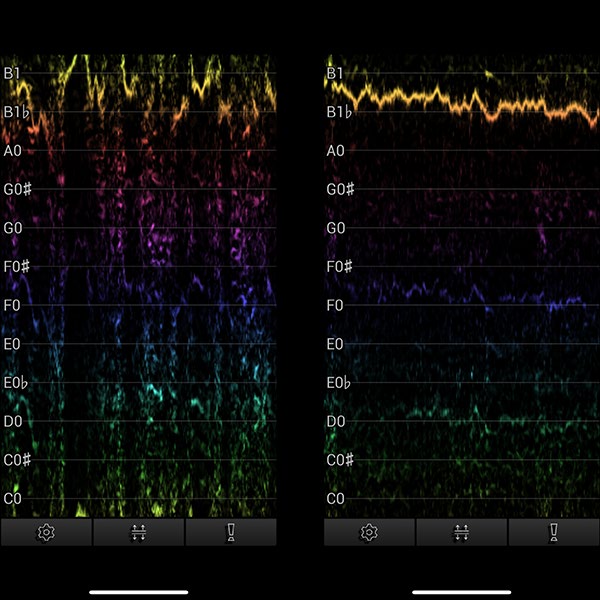
A recording has value in several ways because: sound impairments happen so fast that they can easily be missed and a recording can be reviewed multiple times; the only method to go back in time for comparison is to have already made a recording; optimal evidence (legal or medical) that no unintentional change occurred during an intervention comes from a recording; and physicians who operate near the recurrent and superior laryngeal nerves would have a much better sense of how often the nerves are injured — both temporarily and permanently — and could offer their patients reasonably accurate estimates during a presurgery conference.
Recording from a microphone attached to a laptop computer takes little effort, less than 5 minutes of time, and costs are minimal. The value, however, is enormous.
The Battery of Tests
The following tasks, performed while listening for changes in signal and noise, document a fairly complete vocal exam: reading aloud, maximum phonation time, vocal range (lowest and highest pitch), maximum volume, vegetative sounds, and vocal swelling tests.
Anchor Pitch — Reading
The patient reads a paragraph out loud in a comfortable voice, using the same paragraph for every exam. Reading relaxes the patient and takes the focus away from the examination. While I have not solved the taste issue with topical anesthesia, only ameliorated it, the pain issue should be nonexistent. Lidocaine is an excellent topical anesthetic — combined with a decongestant and some flavoring, the most a patient should experience is a light internal pressure during an exam with an endoscope.
By listening to speech during reading, I determine the approximate average speaking pitch by matching the voice with a note on the piano. I also hear whether there are any speech impairment issues — problems with rate or poor enunciation become audible while reading. If hoarseness is audible during reading, that signals fairly severe breathiness or roughness at the comfortable speaking pitch.
Maximum Phonation Time (MPT)
Using the /i/ sound, I ask the patient to see how long she can sustain /i/ on one breath at her comfortable speaking pitch and comfortable volume. This test, the maximum phonation time (MPT), is a rough measure of how completely closed the vocal cords are. The more closed they are, the less air wasted and the longer the sound can be maintained. With an MPT of less than 10 seconds, most people will complain of being out of breath with talking. Vocally healthy people can typically go beyond 20 to 30 seconds. The more that pitch and volume are kept constant, the more the test measures vocal cord approximation.
Vocal Range
Next, measure the lowest note and the highest note the person is capable of producing, at any volume, to define the pitch range of the voice. In addition to identifying the highest and lowest notes, I am also hearing the quality of the notes throughout the range. An abnormality anywhere within the range becomes a clue to the problem.
Volume — Yelling
I ask the patient to yell robustly — not a scream, but a well-supported yell on the word “Hey.” This adds stress in the form of increased air pressure beneath the vocal cords. This may cause weak vocal cords to flutter. The task may allow stiff vocal cords to actually produce sound when quiet sounds were almost impossible. Psychogenic problems often show up on this test when the patient hesitates or exaggerates performing this task. The important point is to note if the voice is different on this task than it was on previous tasks.
Vocal Swelling Tests
I assess sound production within the vocal range at the very softest volume the patient can produce. There are a number of disorders that impair soft voicing and despite the patient’s interest in solving the voice problem, no one likes to “fail” at a test. I keep coaching them to go softer and softer and emphasize that I want to hear when the vocal cords stop vibrating — that is the goal of the visit.
Generally, we should be able to produce the extreme upper and lower notes of our range at both loud and soft volumes. When we cannot reach the same note softly that we can reach loudly, there is probably a vocal impairment. The greater the difference in vocal pitch range between loud and soft voicing, the more significant the problem.
One of the easiest ways to determine the upper soft range is to have the patient sing the first four words of “Happy Birthday.” Between the syllable “day” and the word “to” is a melodic interval of a fourth. If no sound comes out on the word “to,” or if there is a significant onset delay to the start of vocal cord vibration on that word, then there is some mechanical change in the larynx within this interval of a fourth. Robert Bastian has termed this the vocal swelling test — it is very diagnostic for nodules and polyps. The point at which there is an onset delay signifies the point where a swelling on one vocal cord touches the other vocal cord and dampens the vibration, just like putting your finger lightly on a guitar string.
Vegetative Sounds, Neurologic and Respiratory Findings
I ask the patient to cough, followed by clearing of the throat. This can be helpful in sorting out weakness of the glottis or psychogenic vocal problems. For instance, if a patient could only whisper up to this point in the exam, but can produce a robust cough, then the vocal cords have the capacity to come together and generate sound — they were possibly being held apart with muscle tension.
I observe and comment on neurologic findings of weakness, tremor and spasms if they are noted at any time during the examination. Ordinarily there should be no sound produced during respiration — I make note of any inappropriate sound produced both during quiet respiration and during deep respiration.
Signal and Noise — The Summary Framework
As a shorthand to report vocal capabilities findings, the examiner can think of each assessment in terms of signal (what is functioning correctly) and noise (what is not). Increased noise takes two forms: air leak (white noise from turbulent airflow) and roughness (polyphonia — most often diplophonia). Altered signal takes several forms: onset delays, pitch breaks, regular oscillations of pitch (tremor), irregular interruptions of sound (spasm), and sound during breathing when none should be present.
Since I have been performing these tests often enough and long enough, I can often hear and identify voice problems just walking through a crowd — the accent of speech and the character of voice tell a lot about an individual.
What You Learned
- Singing reveals more than speaking — varying pitch and volume one parameter at a time exposes impairments that conversational speech masks.
- The /i/ vowel is the laryngologist’s friend — it opens the pharynx, facilitates endoscopic visualization, and provides a consistent reference point across exams.
- MPT under 10 seconds signals significant air leak — the vocal cords are not approximating well enough to sustain sound economically.
- The Happy Birthday test identifies swellings — an onset delay on the word “to” (a fourth above the starting pitch) is highly diagnostic for nodules and polyps.
- A robust cough despite whispering reveals nonorganic dysphonia — the vocal cords can approximate; they are simply being held apart by muscle tension.