
May I lay to rest the greatest myth in otolaryngology? Is your hoarseness caused by reflux?
Chances are high, if you have been hoarse and went to see any doctor about it, they prescribed medication for your stomach or a diet change or bed elevation and mentioned how even though you don’t feel it, you should believe this hidden demon inside you is damaging your voice.
For me, the scientific gap in the reasoning behind this nearly ubiquitous diagnosis of reflux laryngitis or GERD or LPR or silent reflux or pepsin damage, is a serious deficit. No author has made a solid connection between presumed reflux causing your hoarseness and actual vocal cord vibration. And if you don’t change vibration, you don’t change sound! If you don’t change sound, your voice did not go from clear to hoarse.
Somehow a story began and it spread with viral effectiveness. I believe the spread started in 1991 with Jamie Koufman writing “The otolaryngologic manifestations of gastroesophageal reflux disease (GERD): a clinical…” and then speaking about her landmark article where she offered a simple fix — a pill — for an audience that despite their extended education did not and may still not understand the relation between vibration impairment and sound change.
I have great respect for Jamie and this was a fascinating, thought-provoking article, but it was an idea piece, not strong evidence and this hypothesis remains a hypothesis thirty plus years later.
Even at this point in my career, I cannot prove beyond doubt that reflux laryngitis doesn’t exist because I have never seen it. However, my skepticism has a solid foundation in physics. I recall a physics class on vibrating strings and how a change in mass or a change in tension will change the rate of vibration and consequently change the pitch. I cannot ever recall anyone dripping acid onto a vibrating string, discoloring the string and deriving a pitch change out of it. So, I would love for someone to show me a patient where acid actually touches the vocal cord without causing a tremendous spasm, and then it changes the mass or the tension on the vocal cord or somehow alters the airflow between the vocal cords. Until then, I remain heartily skeptical of acid reflux as an explanation for the complaint of hoarseness.
The diagnoses of GERD and LPR laryngitis are de facto a wastebasket diagnosis for hoarseness. The physician doesn’t see something, so the issue must be a silent vocal cord killer — reflux.
Considerations
Consider several reasons why diagnosing reflux as a cause of hoarseness is error prone.
- Parsimony (Occam’s razor) suggests that a simple explanation for hoarseness is sufficient — reflux is frequently an unneeded secondary diagnosis.
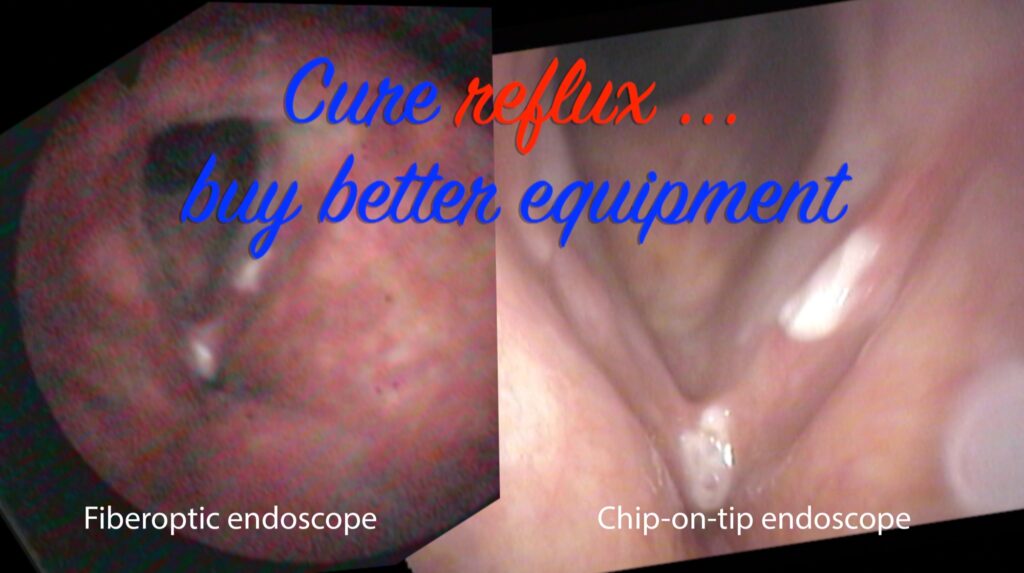
- Redness of the larynx is a digital artifact. Inadequate light and low-resolution fiberoptics lead to a perception of redness; accurate, detailed images describe the diameter of vessels, not the quality of redness. Saying “the larynx is red” is essentially the same as saying “I have a poor-quality view of the larynx.”
- Hoarseness is irregular sound production — an impairment of vibration/movement — and visible causes of voice impairment should relate to the vibratory edge of the vocal cords: swellings, gaps, alignment and stiffness, not to redness or arytenoid edema.
The arytenoids and interarytenoid areas are essentially uninteresting from a vocal perspective. All sound is normally created by the margins of the true vocal cords (the false cord can vibrate). Yet many physicians believe that “laryngeal findings related to LPR are arytenoid and vocal cord erythema, posterior commissure hypertrophy, and arytenoid edema” — structures that are not involved in producing sound.
Understanding the mechanics of sound production makes it unnecessary to invoke a diagnosis of exclusion. Inability to identify a visible lesion is an insufficient reason to diagnose reflux laryngitis, LPR, or GERD.
Parsimony: Reflux as an Unneeded Secondary Diagnosis
Here is a typical report I have seen in a patient who went to a general otolaryngologist for a complaint of hoarseness:
She has distinct vocal cord nodules bilaterally that do not look inflamed. She does have arytenoid edema and erythema that is moderate.
Impression: vocal cord nodules and laryngopharyngeal reflux.
Plan: Omeprazole 40 mg twice a day and rest her voice as much as possible.
Her voice did not improve. On my stroboscopy exam there were swellings on the medial margin of the true vocal cords.
The vocal cords strike in the central portion hundreds of times per second when she speaks. It is sufficient to say the vocal swellings are likely from vocal use or overuse and traumatic closure against each other. There is no need for a secondary diagnosis of laryngeal reflux. Why does one need to imagine that acid from the stomach lands only on the center of the vocal cord margins, or lands everywhere but only causes a swelling on the vocal cord margin?
The Color Red: Redness Is a Digital Artifact
The color red has no impact whatsoever on the function of the voice. The mucosa lining the vocal tract always appears red or pink — look inside your mouth.
Typical fiberoptic endoscopes blur the image of the throat lining with their pixelated view, amplifying this effect of a hazy redness.
With newer chip-on-tip cameras, the fine detail of the mucosa can be clearly resolved. The mucosa is actually translucent, and beneath it can be seen tiny blood vessels — thin, straight, tortuous, dilated, or maloriented. The vessels themselves are always red as they are thin and contain red blood cells flowing through them, and the more vessels there are, the redder the vocal cords appear in a hazy image.
Moving the camera closer to the vocal cords — which increases the available light and reduces digital gain or amplification — makes the perceived “redness” go away.
To cure reflux laryngitis, buy better technology and move your camera closer to the vocal cords.
Arytenoid Edema and Pachydermia
The mucosa between the vocal cords is very loosely attached to the underlying structures — cartilage and muscle — so that one set of cartilages may move over the other with minimal restriction. This loose mucosa can swell and change color. It can be smooth and whitish or redundant and floppy, sometimes resembling elephant skin, and then called pachydermia. However, this tissue is not involved in making sound, so its characteristics are generally a diversion from a correct diagnosis of hoarseness. Neither the color red vibrates, nor does the interarytenoid area.
Listening First
I discuss vocal capabilities extensively as a means of orienting a laryngeal examination. Once a pitch and volume combination is identified that creates the greatest audible vocal impairment, the same pitch/volume combination may be viewed during stroboscopy. A vocally oriented exam is an accurate exam.
There is then no need to use redness, inflammation, reflux, LPR, or GERD as diagnoses of exclusion. Even if a patient improved temporarily with a general anti-inflammatory such as prednisone, one cannot jump to the conclusion that clinical response to empirical medical treatment confirms the diagnosis of LPR.
Mucus Is Not a Sign of Reflux
Mucus is normal. It is the lubricant for vocal cord vibration. However, it does tend to accumulate. The physics of vibration are such that mucus will tend to accumulate at the most dampened portion of vibration — it often points the examiner toward the pathology rather than hiding it. A patient’s sensation of excess mucus or post-nasal drip is often not a result of a problem with the mucus itself, but of dampened vibration leading to accumulation of mucus during vocal use. It is physics in action, not silent reflux in action.
Why Anti-Reflux Medication Sometimes Seems to Help
I met a baritone — we will call him Luigi Senatori — who swore that anti-reflux medication helped his singing. Together, we ran a little single-blind study on this single subject, him. Luigi would come in for several examinations, and I would not know whether he was taking any anti-reflux medication or not. I observed a major and quite significant difference when his secretions were very thick and sticky which at the end of our study corresponded to when he was not taking any anti-reflux medication. When he took ranitidine (Zantac), his secretions were much thinner and did not tend to accumulate on his vocal cords.
I will speculate that since ranitidine is a histamine blocker, there might be some blockade to the production of thicker mucus — perhaps stimulating the serous glands (producers of thin, watery secretions) or blocking the mucous glands (producers of thick, sticky secretions). This effect from the drug may be entirely unrelated to the blockade of acid production in the stomach. My suspicion is that if secretions are made thinner, there will be less tendency for secretions to accumulate on any pathology of the vocal cords. The patient with a vibratory problem will have the sense that their voice improves somewhat on the medication, even if the underlying problem has not changed.
Dr. Zubiaur and I published a review of how often I see the diagnosis of reflux laryngitis where I find it is not the cause of a voice disorder: Thomas, J.P. & Zubiaur, F.M., Over-diagnosis of laryngopharyngeal reflux as the cause of hoarseness. Eur Arch Otorhinolaryngol (2013) 270: 995.
What you learned
- Reflux laryngitis has become the default diagnosis of hoarseness when no visible lesion is found — but the physics of vocal cord vibration make acid reflux an implausible explanation for impaired vibration.
- Redness of the larynx is a digital artifact of low-light fiberoptic imaging; moving the camera closer eliminates the perceived redness. Color has no effect on vocal cord vibration.
- Arytenoid edema and pachydermia are not causes of hoarseness — the interarytenoid area plays no role in sound production.
- Mucus accumulates where vibration is dampened; it points toward pathology (dampened vibration) rather than indicating reflux.
- When anti-reflux medication appears to improve the voice, the likely mechanism is thinning of secretions via histamine blockade — not suppression of stomach acid reaching the larynx.
- A diagnosis of exclusion (“no lesion found, therefore reflux”) is not adequate; understanding vocal mechanics should lead to a correct diagnosis in virtually every case.