
John Sackett has had trouble with a hoarse voice for the past four years. Whenever he uses his voice for more than two hours he tends to lose it. His family doctor corrected a problem with hypothyroidism thinking there might be a relationship, but there was no concurrent change in his voice. He has been accepted to law school and feels that he now must deal with his voice problem to be successful.
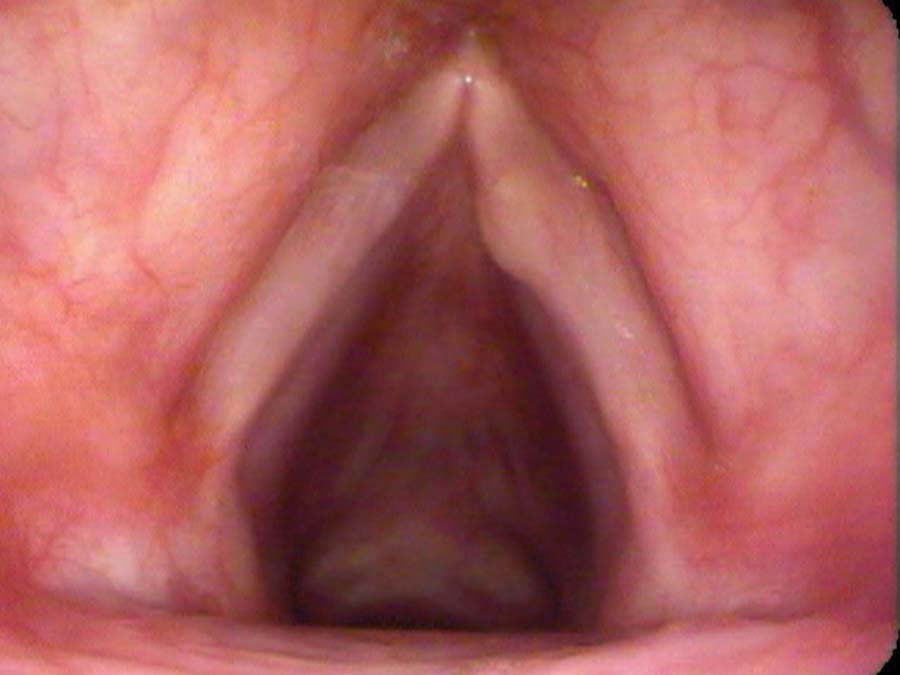
There are mucous glands along the inferior vibratory margin of the vocal cords that can become obstructed. When plugged (behaving similar to a pimple or sebaceous cyst on the skin), a cyst containing mucus forms. These occur anywhere along the length of the vocal cord, unlike nodules and polyps which are almost always in the center. When there is a one-sided swelling that is not in the mid-portion of the vocal cords, a cyst statistically becomes the most likely diagnosis.
When there is a one-sided swelling that is not in the mid-portion of the vocal cords, a cyst statistically becomes the most likely diagnosis.
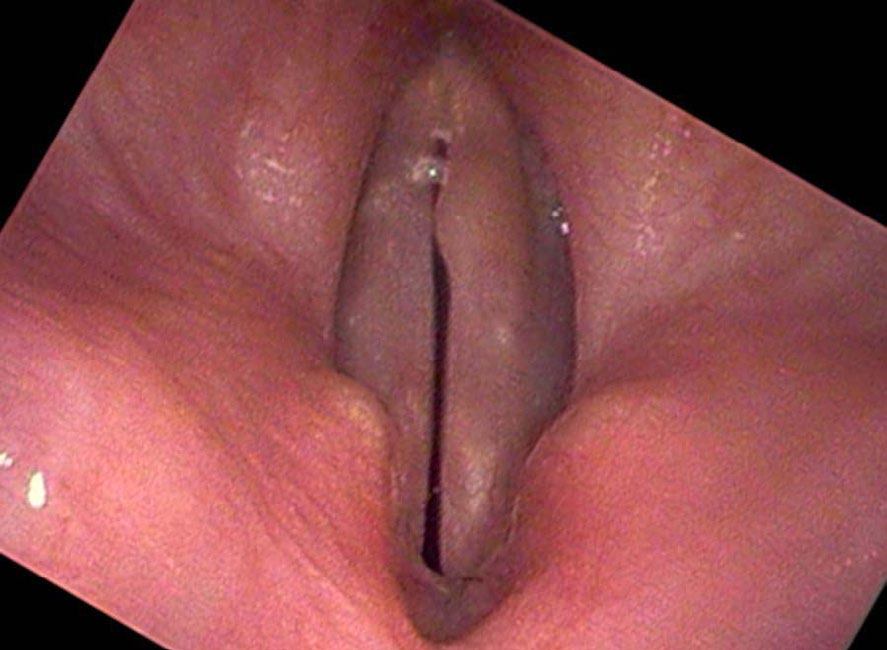
As a cyst swells, it impairs the voice by creating stiffness as well as a bump and so can impair the voice much like a polyp. If the cyst enlarges, the vocal cord vibrates at a lower pitch because of the heavier mass. Consequently, an examiner might hear husky hoarseness as well as diplophonia or roughness. Occasionally, a cyst ruptures and drains out and sometimes they plug up again. Most commonly, cysts persist unless they are surgically removed.
John ended up having his cyst surgically removed, recovering almost all of his vocal range. Because a cyst is deeper within the vocal cord than a nodule or a polyp, there is more often some leftover stiffness from scarring when the cyst is removed. His vocal edge was straight. His speaking voice was normal, but just there was just enough stiffness at the surgical site of the cyst removal to impair some of his highest pitches.
What you learned
- A vocal cord cyst forms when a mucous gland along the inferior vibratory margin becomes plugged — similar to a sebaceous cyst on the skin.
- Unlike nodules and polyps (which form at the midpoint of the cord), cysts can appear anywhere along the cord’s length — making their location the key diagnostic clue.
- A cyst causes hoarseness both by creating a bump that prevents cord closure and by stiffening the cord, reducing its ability to vibrate freely.
- Surgical removal usually restores the voice, though cysts sit deeper than nodules, so some residual stiffness at the removal site is common and may affect the highest pitches.