
Barry Black is in his mid-20s and notes that speaking has gradually become effortful for the past 2 years. He feels like something is swollen in his throat although it does not affect his eating. He feels discomfort after speaking loudly for a period of time. His voice cracks like it did in puberty. He saw an ENT who told him that he had vocal cord polyps.
During his audible examination, his voice leaked a lot of air in his upper range so that he had a husky hoarseness when trying to sing in falsetto. On the endoscopic examination 2 large hemispherical masses were present on the bottom edge of the false vocal cords. When he closed his vocal cords together to produce sound, these put pressure on the true vocal cords and kept them from vibrating well or completely. The harder he squeezed, the more they rubbed against the true vocal cords.
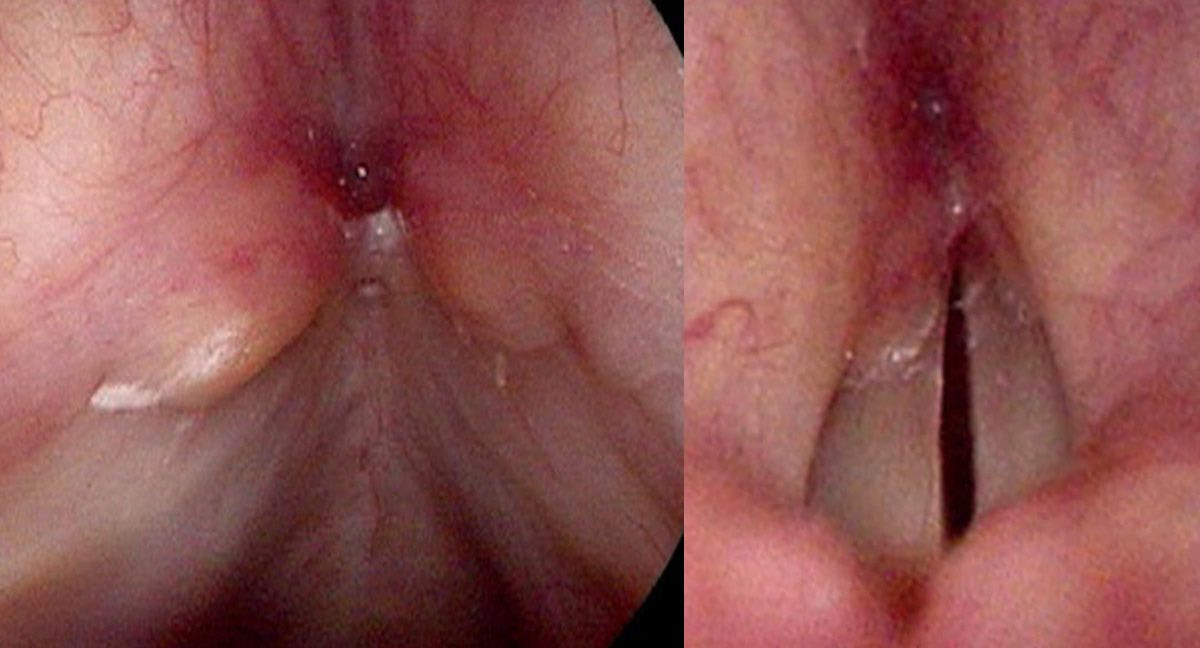
Healthy saccules typically contain mucus and are fairly small. If they become plugged, they may enlarge to this size or larger and dampen the vibrations of the vocal cords.
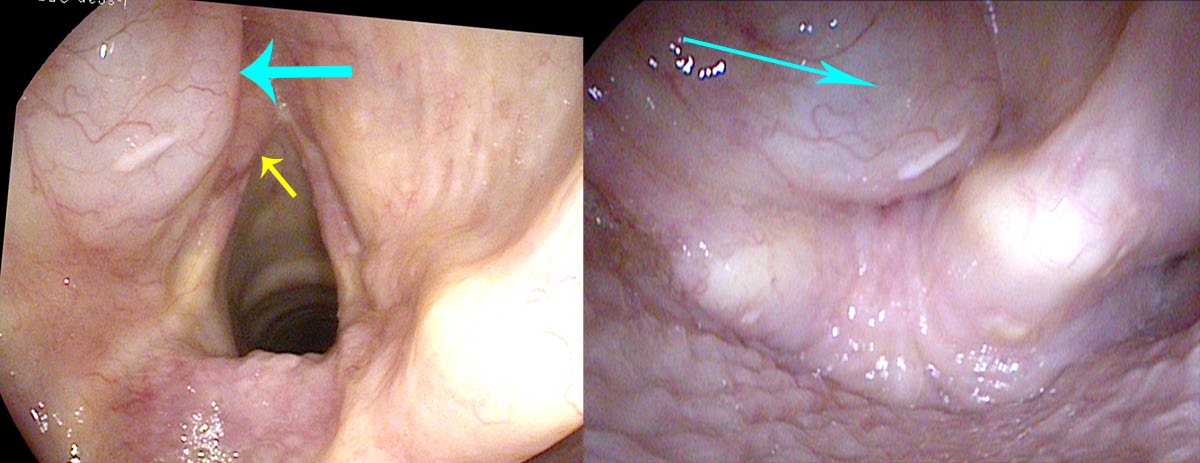
Healthy saccules typically contain mucus and are fairly small. If they become plugged, they may enlarge and dampen the vibrations of the vocal cords.
What you learned
- The saccule is a small gland on the underside of the false vocal cord; when it becomes plugged, it can enlarge into a saccular cyst visible from above.
- Saccular cysts cause hoarseness by pressing down on the true vocal cords from above — and the harder the patient squeezes to make sound, the more friction is created.
- The location of the swelling (along the bottom of the false cord, not at the midpoint of the true cord) distinguishes a saccular cyst from a nodule or polyp.
- Surgical removal of the enlarged saccules resolves the elevated vocal effort that comes from compensating for impaired cord vibration.