
I tend not to see bacterial infections of the larynx. I suspect that they are either self-limited and resolve from the body’s own immunity in fighting the infection, or quite possibly they are treated with antibiotics in the primary care setting.
Supraglottitis — An Airway Emergency
One type of infection of the larynx often called epiglottitis — that perhaps more appropriately might be called supraglottitis — is typically a bacterial infection of the upper portion of the larynx. The vocal cords have a very limited ability to swell acutely. When they do swell even a small amount, they become rather stiff and unable to vibrate. The person loses their voice, but continues to breathe rather normally.
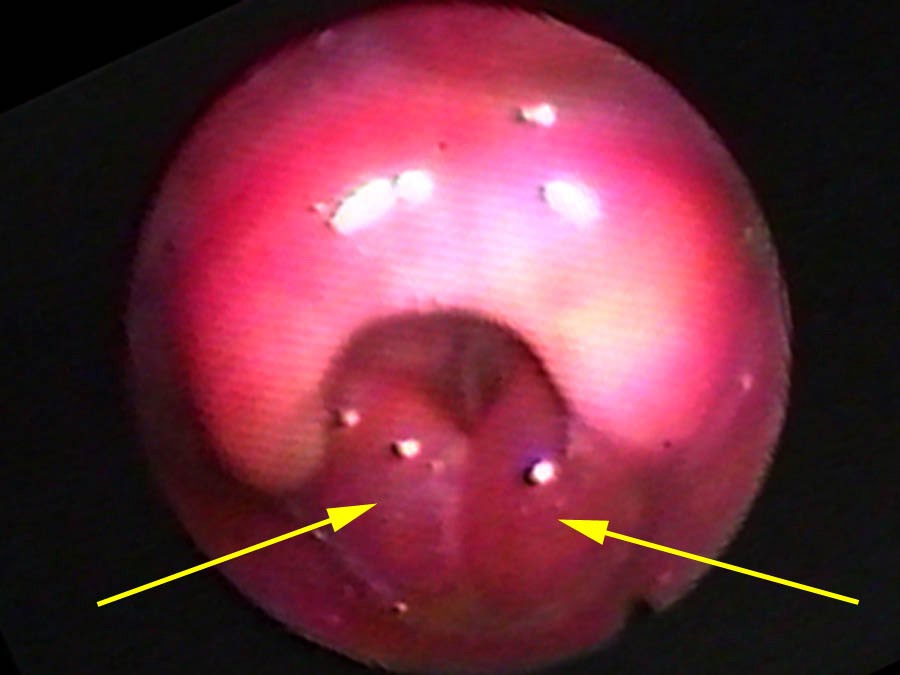
When a bacterial infection involves the upper part of the larynx, the supraglottis, a great deal of swelling may occur and it may progress rather rapidly over hours. The mucosa or surface tissue is very loosely attached especially at the back and a great deal of fluid can accumulate beneath the tissue. So much swelling may occur that the tissue begins to suck into the airway creating noise and difficulty breathing. The epiglottis is often swollen, but typically it is the mucosa covering the arytenoids at the back of the larynx that is so loosely attached that when swollen, the supraglottic mucosa begins to suck into the larynx when breathing in. This type of infection has been known to completely block off the airway.
The Smoldering Low-Grade Infection
Occasionally I see a low-grade smoldering infection of the larynx that presents as apparent dryness of the vocal cords along with some dilation of the capillaries on the vocal cords with stiffness. While this rather benign dryness doesn’t behave aggressively, a culture taken from the surface of the vocal cords can reveal bacteria and treatment can then be based on the bacteria found.
Bacterial infections of the larynx are rather uncommon. I have probably prescribed antibiotics for a vocal cord problem less than five times in 9,000 patient visits. Antibiotic treatment of hoarseness is very low on my list of treatment options.
What You Learned
- True bacterial infections of the larynx are uncommon — most hoarseness attributed to bacterial infection is actually viral, behavioral, or from another structural cause.
- Supraglottitis (bacterial infection of the supraglottis) is a potential airway emergency: swelling of the loosely attached arytenoid mucosa can progress rapidly and suck into the airway during inspiration.
- The epiglottis is typically swollen but it is the arytenoid mucosa that most commonly narrows the airway — making “epiglottitis” a somewhat misleading term.
- A low-grade smoldering bacterial laryngitis exists: it presents as dryness, capillary dilation, and stiffness, and can be confirmed by surface culture.
- Antibiotics are rarely the answer for hoarseness — accurate diagnosis matters far more than the power of the medication.