
When one vocal cord is stiffer than the other, the two cords try to oscillate at different amplitudes and pitches. In mid-range, this creates audible diplophonia. Paradoxically, a completely stiff cord would produce a clearer voice than a partially stiff one.
Asymmetric Stiffness
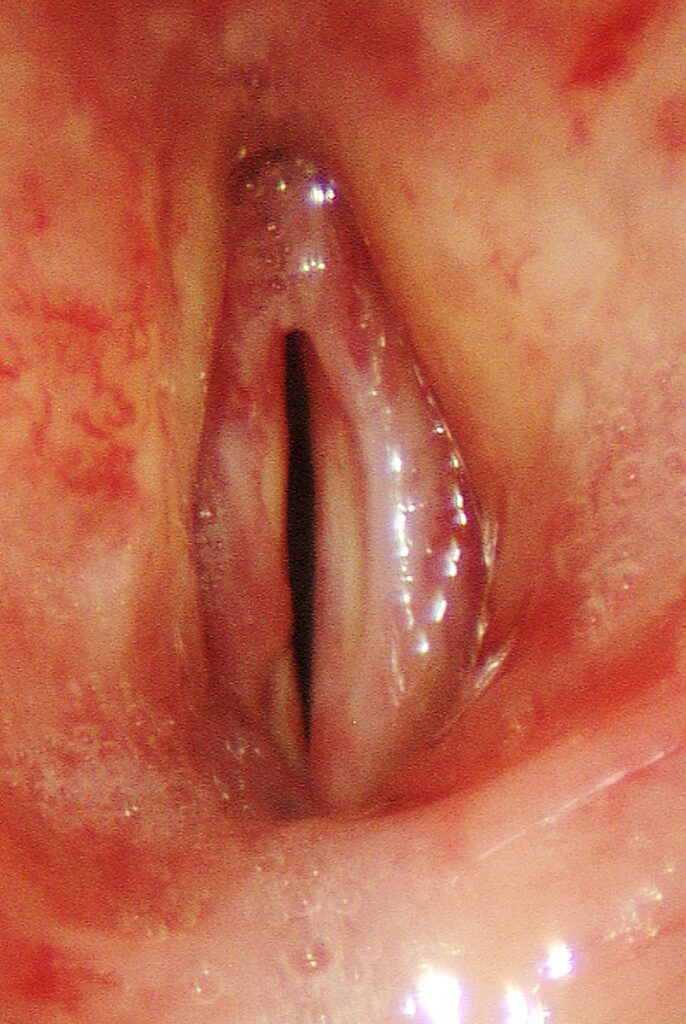
Sarah had a vocal nodule stripped from one cord years ago. Her speaking voice sounds fine, but through most of her middle and upper range, her voice deteriorates and breaks up. Using stroboscopy, one cord is very stiff and the other supple. At her lowest notes, the stiffness difference causes different amplitudes but the same pitch — no diplophonia. In her mid-range, the cords go out of sync, each producing a different note, and the diplophonia is very audible. At her highest notes, the stiff cord is pulled so tight it does not vibrate at all, and all the sound comes from the flexible cord — producing a surprisingly clear, single-cord tone.
The stripping removed not just the mucosa but also the lubricating lamina propria. When the cord healed, the new mucosa adhered directly to the vocal ligament, making it much stiffer than the other side.
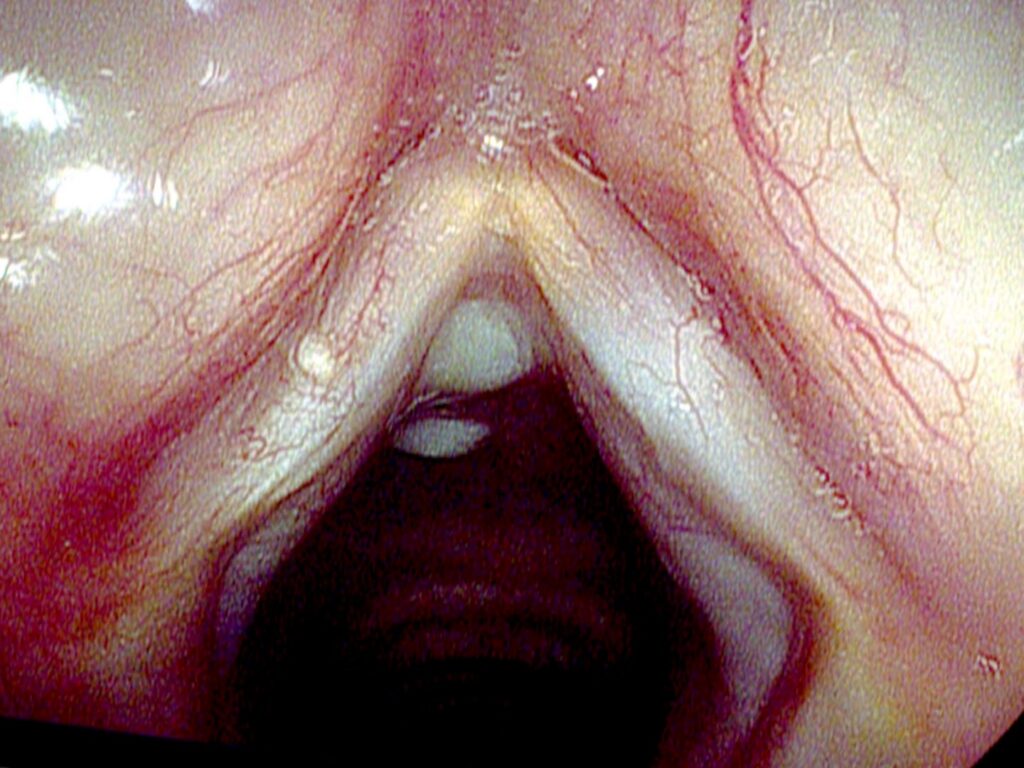
Linus is 74 and had a vocal cord biopsy revealing cancer, followed by radiation therapy 12 years ago. His voice is rough. On stroboscopy there is a supple mucosal wave on the right; the left cord oscillates, but stiffly. He ends up with two sound sources from asymmetric stiffness. Interestingly, if the left cord were completely stiff and did not oscillate at all, his voice would be clearer — one cord creating a pure pitch, with no competing vibration from the stiff side.
A completely stiff cord that does not vibrate at all produces less roughness than one that vibrates partially — because it creates no competing pitch.
What You Learned
- Stiffness asymmetry causes pitch-dependent roughness — most audible in mid-range where both cords are still vibrating but at different amplitudes and phases.
- Stripping can remove the lubricating layer — loss of the lamina propria causes the mucosa to adhere directly to the ligament, permanently stiffening the cord.
- A paradox: partial stiffness is worse than full stiffness — a completely non-vibrating cord creates no competing pitch, while a partially stiff cord vibrates at a different frequency, generating roughness.