
A mass asymmetry — such as a hemorrhagic polyp on one vocal cord — creates multiple dysphonias at once: rough hoarseness at low pitch, pitch breaks and squeaks in mid-range, and a split high pitch as the polyp divides the cord into segments.
Asymmetric Mass & Length
Norm is an unabashed sports fan who yelled enthusiastically at a Friday night football game, lost his voice by the end, and has had roughness ever since. His voice sounds progressively rougher through the course of a conversation, and his voice cracks and squeaks when he glides up in pitch.
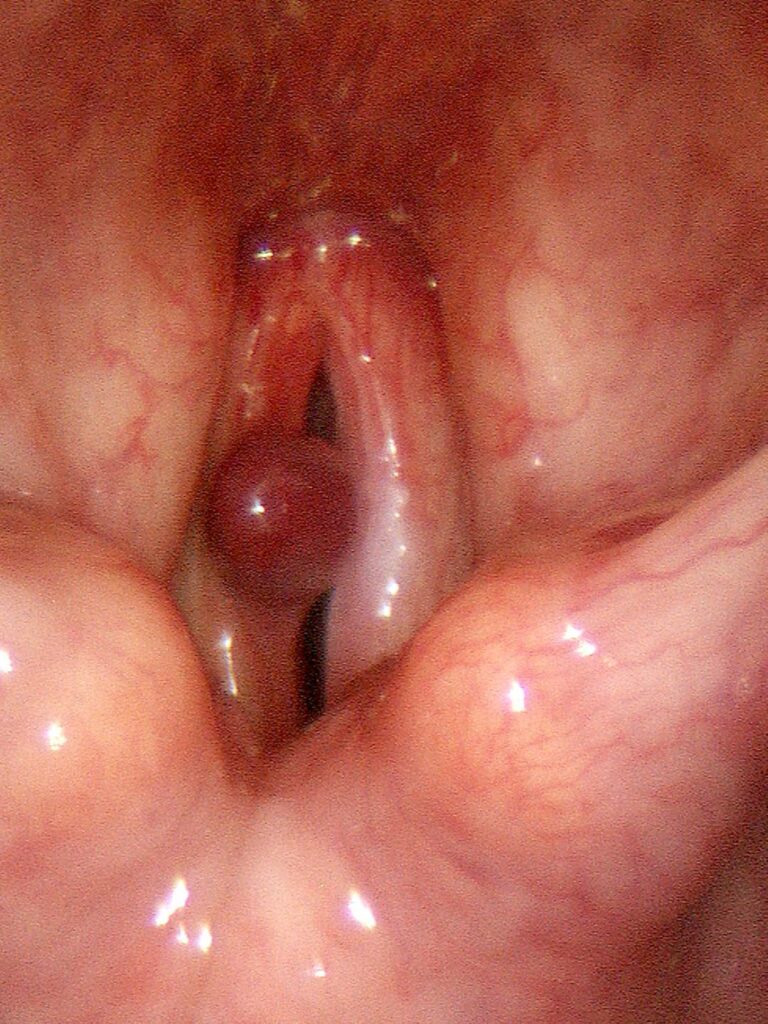
A large hemorrhagic polyp hangs on the edge of one vocal cord, adding mass. As he vibrates his vocal cords, the polyp is whipped back and forth and fills with more blood as he continues talking — making this vocal cord heavier and heavier. When the mass difference is great enough, the two cords vibrate separately at different pitches. This mass-based hoarseness is most evident at low pitch.
Norm provides insight into the complexity of hoarseness — his polyp creates rough hoarseness at low pitch, pitch breaks in mid-range, and split pitches at high pitch, all from a single lesion.
In the middle of his range, progressive tightening of the vocal cords brings the polyp into contact with the opposite cord, throwing vibrations off — pitch quits, squeaks, or breaks up into roughness. At high pitch, the polyp compresses against the other cord, stopping vibration in the middle and leaving each end to vibrate separately at its own pitch. If the polyp is precisely centered, both segments are short and equal, each vibrating about an octave higher. If the polyp is slightly off-center, two distinctly different high pitches are heard simultaneously.
What You Learned
- A polyp creates pitch-dependent asymmetries — mass asymmetry at low pitch, contact-driven pitch breaks in mid-range, segment-length asymmetry at high pitch.
- A hemorrhagic polyp grows during use — each vibration whips blood further into the polyp, progressively worsening the mass difference throughout a conversation.
- Patients compensate by holding cords apart — avoiding the mid-range pitch break by increasing air leak is a key sign of a mid-cord swelling.