
When tension between the two vocal cords is unequal, the looser cord buckles and flutters at low pitch while the tighter cord holds its form. The result is diplophonia — two pitches heard simultaneously — perceived as roughness.
Asymmetric Tension
Faith lost her voice suddenly for no apparent reason. Her primary physician predicted improvement with time, and some voice did return — but it was higher pitched and softer than before. After several months, she came to the office still hoarse.
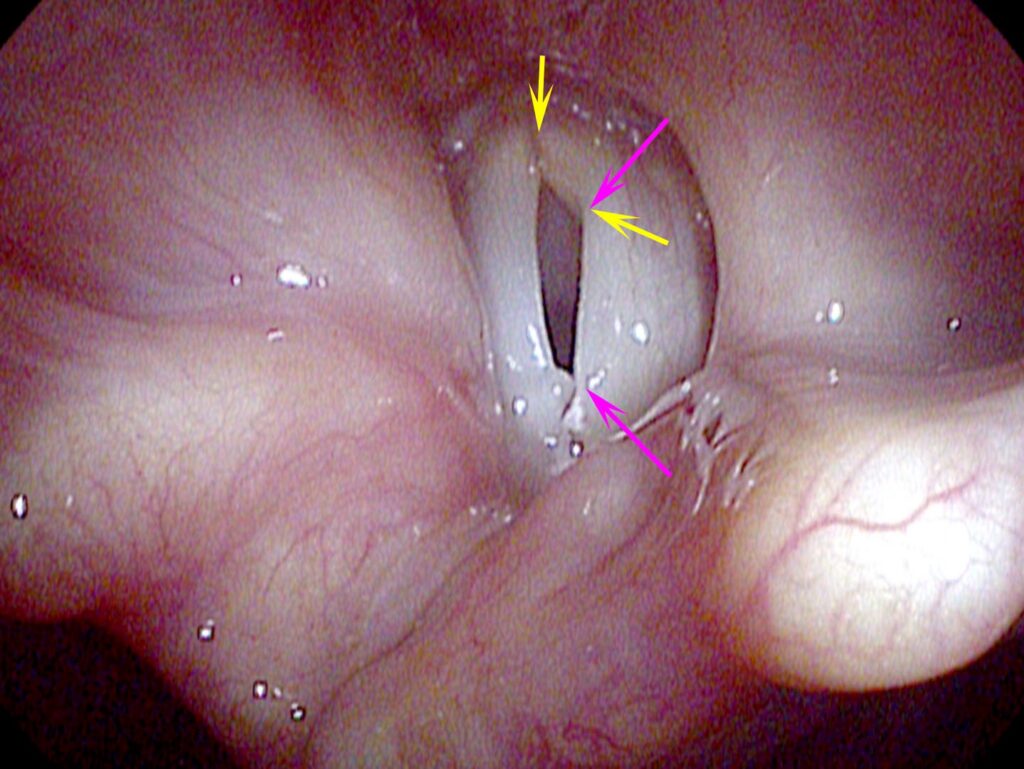
Asked to start at a high note and gradually descend, her voice at the highest notes is fairly clear and fairly robust. At a lower pitch, approaching the typical speaking pitch for a female, she loses volume. Below that pitch, her voice becomes very rough. When her vocal cords are observed as she descends toward the lowest pitches, one vocal cord becomes loose, bows, buckles, and ultimately flutters in an irregular pattern.
Faith’s rough vocal quality is due to uneven tension between the vocal cords. The uneven tension is partially compensated at high pitch — remaining subtle and hidden. Her comfortable speaking pitch is automatically higher than it used to be as she unconsciously tries to compensate by tightening the vocal cords to avoid the flutter. In her lower range, however, the difference in tension is pronounced and at some point each vocal cord vibrates at a separate pitch.
Faith’s roughness is due to uneven tension. Two pitches produced simultaneously and sonically competing with each other are irregular vibrations — diplophonia.
What You Learned
- Uneven tension causes diplophonia — at low pitch, the looser cord buckles and vibrates at a different frequency, creating two simultaneous pitches perceived as roughness.
- High pitch compensates, low pitch reveals — CT tightening masks the tension difference at high pitch; descending in pitch progressively removes that compensation.
- The voice rises to compensate — patients automatically raise their habitual pitch to avoid the flutter zone, a sign that can point the examiner to the diagnosis.