
A whisper is the extreme case of husky hoarseness — the vocal cords held apart so that only turbulent airflow is produced. Understanding the whisper clarifies how any gap between the vocal cords creates huskiness.
Whisper — Pure Air Leak
To understand husky hoarseness, it is helpful to think of one of the extreme types of sound production we can make with our larynx: extremely soft sound. We can generate sound in the larynx with the vocal cords in a partially or completely open position — that sound is called a whisper.
During normal sound production, the membranous vocal cords lie parallel to each other and vibrate — opening and closing. In a true whisper, the vocal cords do not vibrate. The airflow is increased and as it passes a narrowed spot, turbulence is created. Airflow that is turbulent consists of many different pitches simultaneously: white noise.
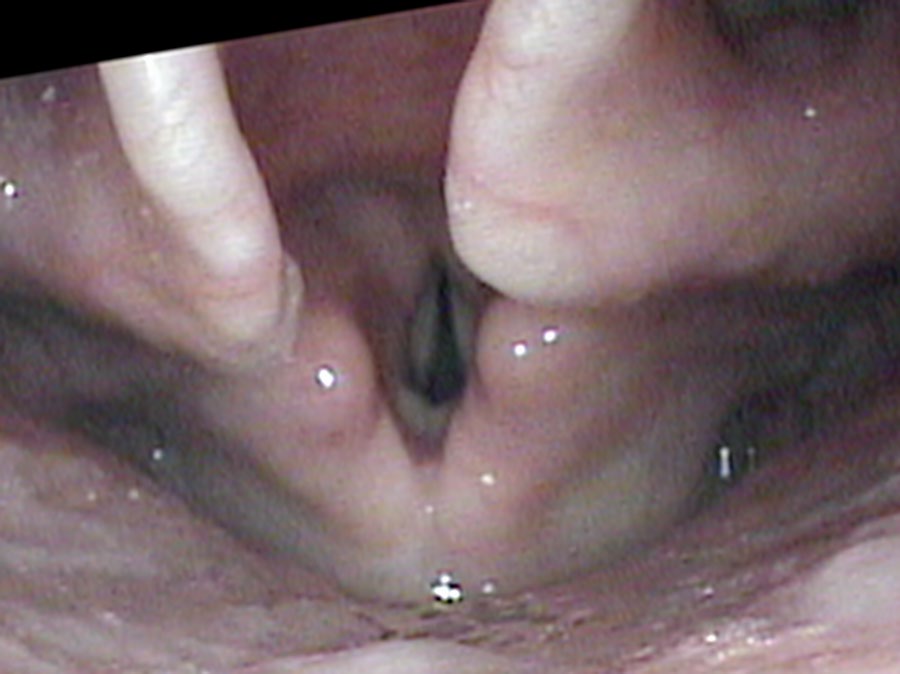
In a true whisper, the back of the larynx might be open between the vocal processes while the membranous vocal cords might be closed such that all the air is forced out through this triangular opening at the posterior end of the membranous true vocal cords. The signal generated by airflow through this triangle consists of white noise — it lacks intensity and cannot be heard well or from very far away.
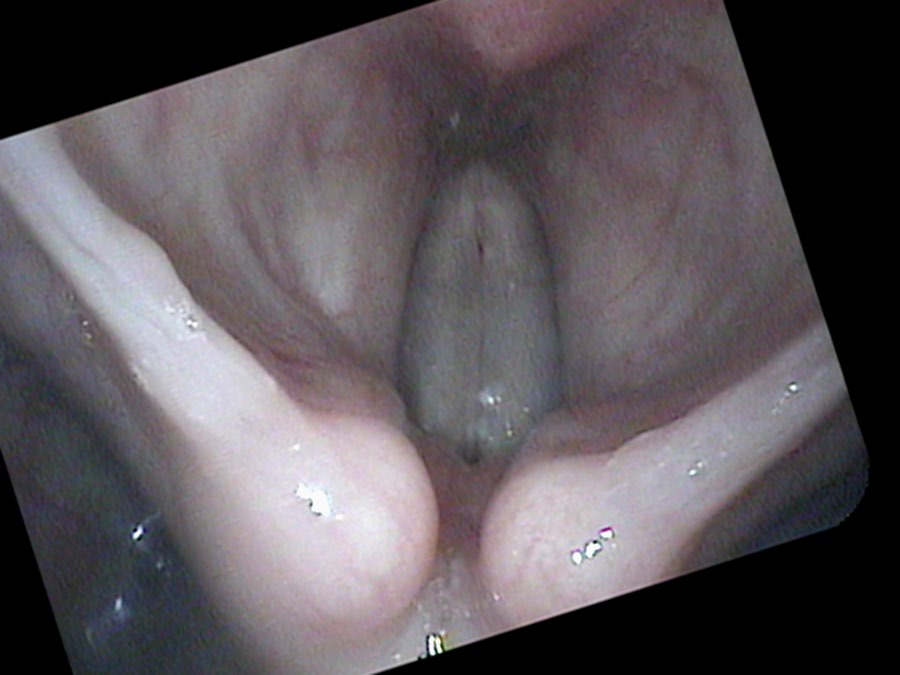
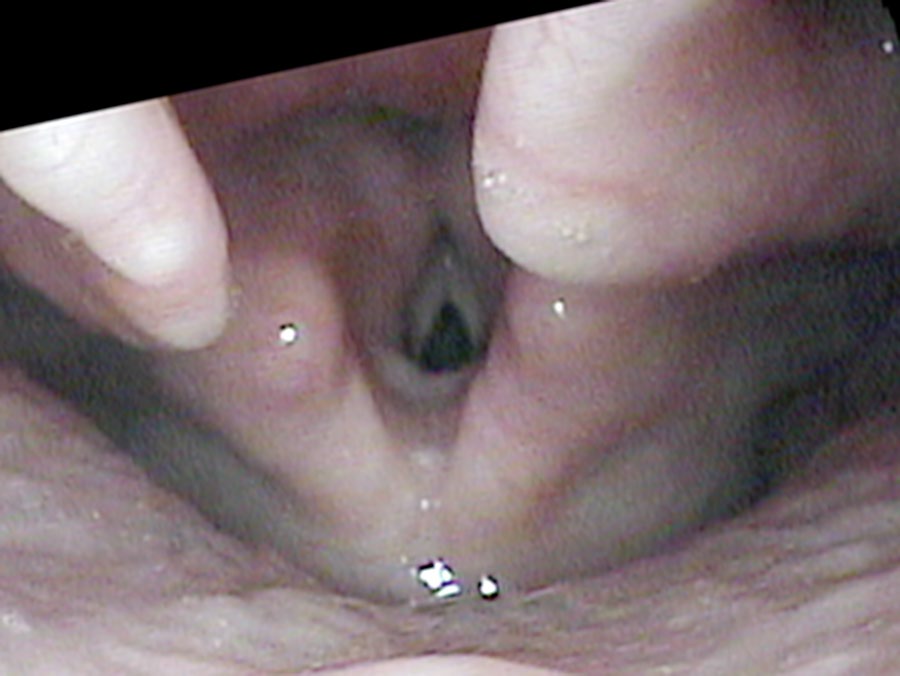
In between a whisper and a clear tone, any gap between the vocal cords adds a commensurate degree of turbulence — perceived as a huskiness of the voice.
A stage whisper is meant to sound like a whisper, yet the audience needs to hear the speaker. In a stage whisper for a theatre production, the vocal cords are allowed to vibrate a little, so that the sound has the character of white noise, but enough vibration for the sound to carry. A stage whisper is really a mixture of air turbulence and some vibration.
In between a whisper (cords not vibrating, very low signal to noise ratio) and a clear tone (cords completely parallel, very high signal to noise ratio), we can have some mix of a pure tone and white noise. The white noise gives the voice a husky quality. So while a whisper is the extreme of turbulent airflow through the larynx, any gap between the vocal cords will add a commensurate degree of turbulence perceived as huskiness. We may desire that quality, but if we don’t, it is hoarseness.
What You Learned
- A whisper is pure white noise — no vocal cord vibration, just turbulent airflow through a narrowed larynx.
- Any gap creates huskiness — the whisper is the extreme end of a continuum: any posterior opening leaks air and adds noise to the voice.
- White noise blends into background noise — whispers carry poorly, especially in environments with ambient sound.
- A stage whisper mixes vibration and turbulence — intentionally adding a small amount of vibration allows the whisper character to carry across a theatre.