
The CT muscle is located on the exterior of the larynx. By rocking the thyroid cartilage forward on the cricoid cartilage it stretches the vocal cords, providing the falsetto (upper) register and allowing projected speaking with less effort.
The CricoThyroid (CT) Muscle
The CT muscle is located on the exterior of the larynx, just under the skin. The thyroid cartilage pivots or rocks forward on top of the cricoid cartilage when the CT muscle contracts.
Inferior to the thyroid cartilage and superior to the cricoid cartilage is a groove. If you place your finger in the groove and attempt a high pitch sound, you will feel this groove pinch closed as the cartilages are pulled together. The CT muscle pulls these cartilages toward each other. It is located to the side of the middle groove.
The effect of this rocking is to stretch the vocal cords. For a singer, the additional tension provided by stretching the vocal cords provides the falsetto (upper or head) register. The tension of the CT muscle also allows us to yell with less effort.
The CT muscle stretches the vocal cords to provide the falsetto register — and is the primary pitch-control muscle in the upper range.
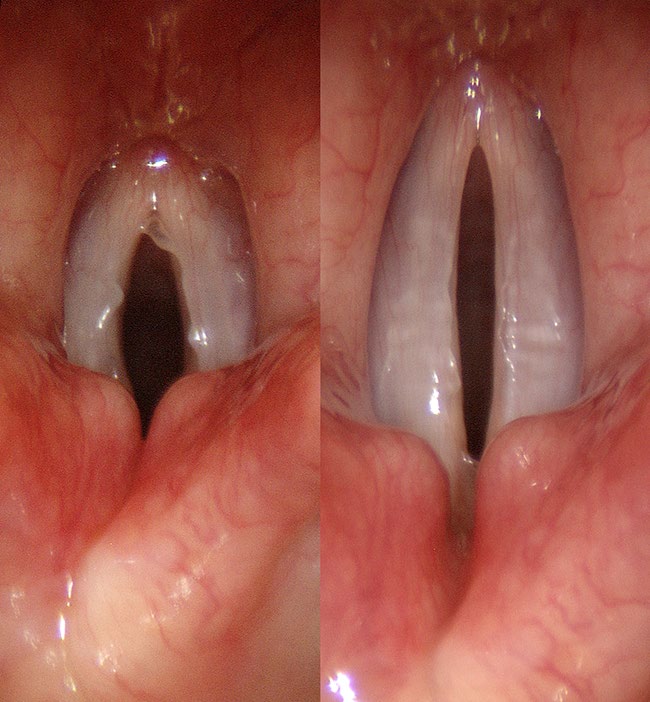
Some common complaints when this muscle is not working are: inability to sing as high as in the past, additional effort to project as loud, and discomfort with projected speaking.
This muscle is not visible directly on endoscopy since it is attached on the external surface of the thyroid and cricoid cartilages. The effect of the muscle though is easily visualized as a lengthening of the vocal cord as the pitch is increased during phonation.
The fact that we have two muscles to change pitch — one primarily low in the range (TA) and the other primarily high in the range (CT) — means that there is a midrange location where the tensioning of the two muscles blend together. For singers, this is the area of the vocal break. Classical singers spend a great deal of time smoothing the transition between the use of these two muscles.
What You Learned
- The CT muscle is external — attached to the outside of the thyroid and cricoid cartilages; it is not directly visible on endoscopy.
- It stretches the vocal cords — by rocking the thyroid cartilage forward on the cricoid, it lengthens the cords to raise pitch in the upper range.
- CT provides the falsetto register — without CT function, singers lose high notes and speakers lose easy projection.
- TA and CT blend at mid-range — the “vocal break” in singers occurs at the transition between these two pitch-control muscles.