
“I first became hoarse about five to seven years ago. It is hard to really remember when it first started since it came on gradually. About two years ago, I really noted the hoarseness increasing. It takes a lot of effort to speak and sometimes my voice breaks like a teenage boy. With even the slightest cold, I lose my voice completely. On the phone, people are always asking me if I smoke!” Julie Trappe reports, sounding concerned.
Listening to her voice, it is very rough and strained and she essentially has only a single pitch with an occasional higher pitched squeak. She has a maximum phonation time of seven seconds on one breath, quite short for a healthy person in her mid-forties. On endoscopy there is a large, smooth surfaced swelling involving the back half of the left false vocal cord and also either covering or involving the top back portion of the true vocal cord. This is an unusual location for a mucocoele, which is usually in the ventricle near the front of the vocal cords rather than the back (posterior). Otherwise, the swelling looks like it could be a tumor. A CAT scan shows that the center of the mass is calcified.
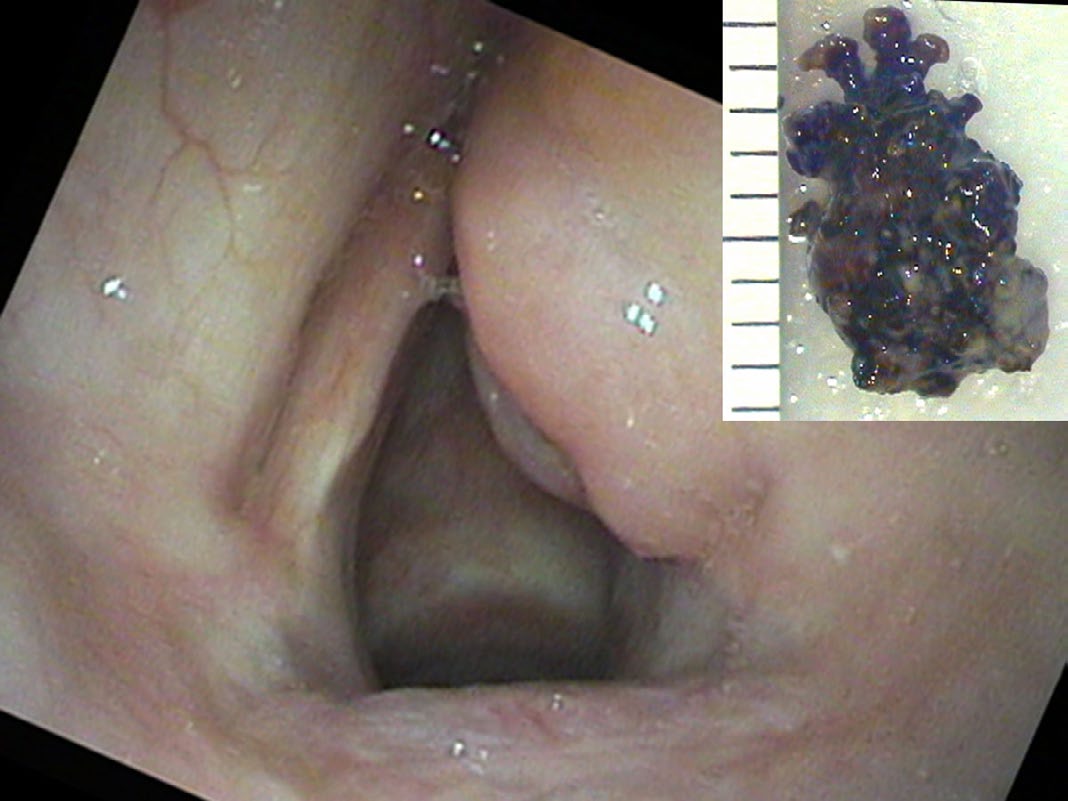
My suspicion is that a food particle became trapped in the ventricle and the secretions from the throat gradually deposited minerals such as calcium on the particle. Over many years as the deposits gradually increased the size of the stone, the inflammation increased.
At surgery, the tissue removed was inflammatory tissue and lodged in the posterior ventricle was an irregularly shaped stone or calcification. My suspicion is that a food particle became trapped in the ventricle between the false and true vocal cords and the secretions from the throat gradually deposited minerals such as calcium on the particle. Over many years as the deposits gradually increased the size of the stone, the inflammation increased. A swollen vocal cord doesn’t vibrate well and a swollen false vocal cord that rubs on the true vocal cord impairs vibration further. She healed up in about two months with no further problems.
It is possible for foreign bodies to become lodged between the vocal cords. Some foreign bodies are small enough to pass between the vocal cords and lodge in the lungs. Small bones from fish or other meat products can impale themselves. Surgical implants in the vocal cords can extrude and lodge in the larynx. Almost any foreign body of the appropriate size could lodge in this area.
What you learned
- Foreign material — including food particles — can become trapped in the laryngeal ventricle (the space between the true and false vocal cords) and gradually accumulate mineral deposits to form a stone (laryngeal calculus).
- A calcified center on CT imaging is a key finding that distinguishes a calcified foreign body from a soft tissue tumor or simple mucocoele.
- The resulting inflammatory swelling impairs true cord vibration directly, and a swollen false cord pressing down on the true cord worsens the problem further.
- Unusual posterior location (back of the ventricle rather than front) and a calcified CT center should raise suspicion for a trapped foreign body even when no particle ingestion is recalled.
- Surgical removal resolves the chronic inflammation and voice impairment completely once the source is identified and removed.