
Pandit, a young man in his thirties, called me asking if I could lower the pitch of his voice. He has been called “ma’am” on the phone far too often. His voice has been high pitched his whole life. The louder he tries to speak, the more his pitch will go up. He frequently “squeaks” when speaking.
Congenital Missing Muscle
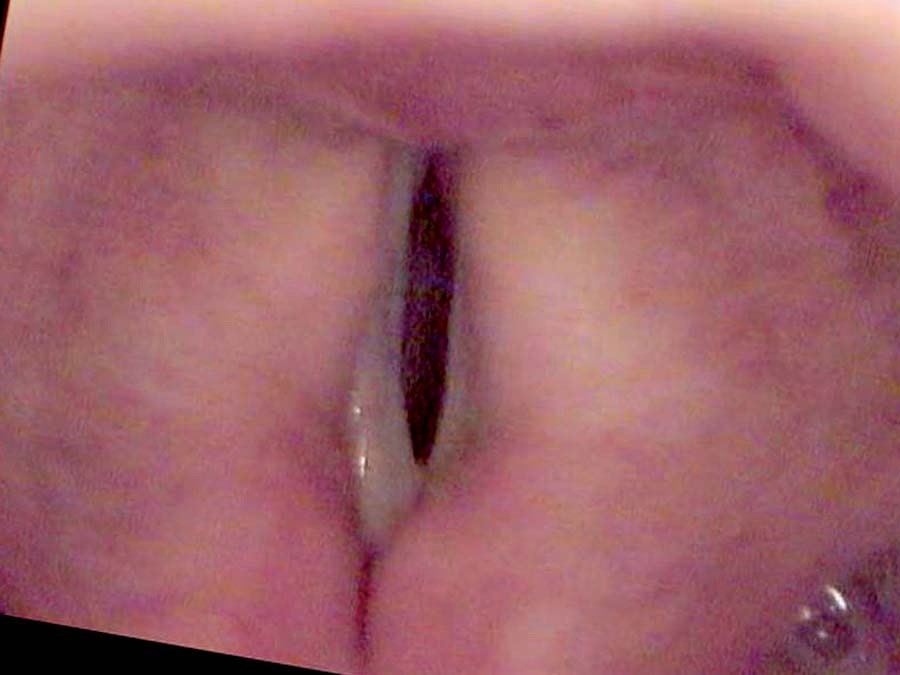
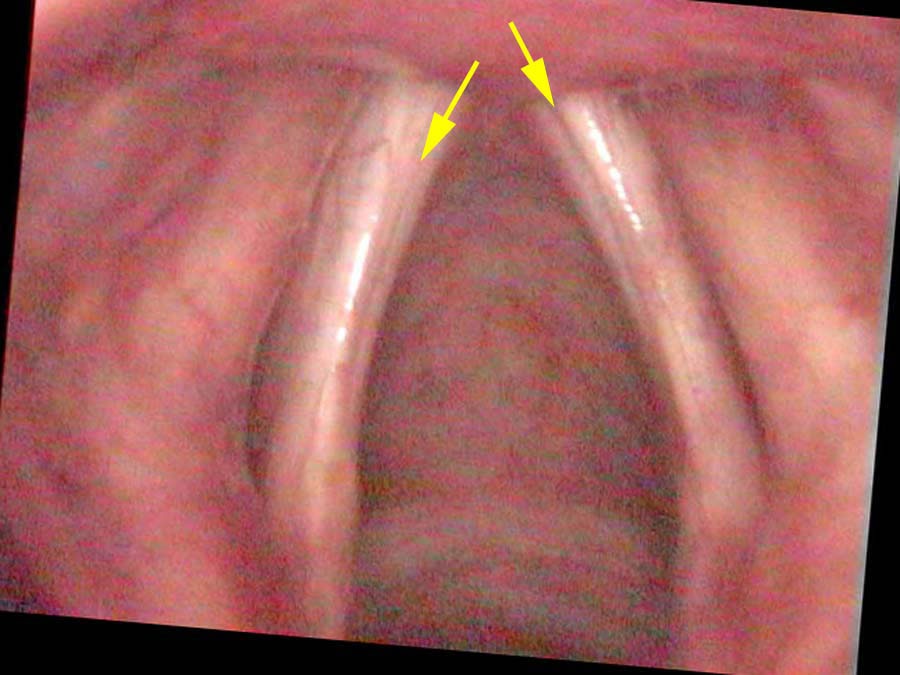
On endoscopic exam both vocal cords are bowed and very thin. There appears to be a groove running along the length of the entire vocal cord. That groove could be a scar, but seems to me to represent such significant atrophy of his vocal cord muscle or TA muscle, that the vocal ligament is the main supporting structure of the vocal cord. The mucosa appears to be draped over the ligament, then there is the groove and below that, perhaps a tiny bit of muscle.
You might reasonably ask how a person can speak without the main muscle inside their vocal cords. Effectively Pandit is speaking in falsetto full time. Because we have two muscles to raise pitch (TA and CT), if one is missing or impaired (the TA muscle in this case), the other muscle takes over as compensation. The CT muscle contracts, pulling the vocal cords longer and tighter. This brings the bowed vocal cords closer together so they can vibrate more easily, but it also raises the pitch.
Effectively Pandit is speaking in falsetto full time.
Cause
It seems to me, the most likely etiology for this disorder is that a person is born with small thyroarytenoid muscles (or very atrophic muscles or with a damaged nerve to the muscles – they are innervated by the last branch of the recurrent laryngeal nerve). It is certainly plausible that some infection causes a destruction of the tissue within the edge of the vocal cords.
Treatment
The best results I have had in accommodating this problem are to place bulking implants in both vocal cords. That adds only a little tension, but the bulk places the vocal cords closer together and increases their mass. The cricothyroid muscle then contracts less, so the relaxed speaking pitch may drop.
What you learned
- Sulcus vocalis is a groove along the vocal cord caused by severe atrophy or absence of the thyroarytenoid (TA) muscle, leaving the vocal ligament as the main structural support.
- Without the TA muscle, the CT muscle compensates by pulling the cords longer and tighter, locking the speaking pitch into an involuntary falsetto.
- The condition is most likely congenital — born with underdeveloped or absent TA muscles — though infection destroying the vocal cord edge is also possible.
- Bilateral bulking implants increase vocal cord mass and bring the cords closer together, allowing the cricothyroid muscle to relax and the speaking pitch to drop toward normal.