
Talkativeness is an innate personality trait — and one of the strongest predictors of vocal cord swellings. Understanding where a patient sits on the talkativeness scale shapes both the diagnosis and the treatment plan.
I ask Mrs. Chatterly to tell me about her problem. "Doc, I talk all the time. I'm off the top of your scale of talkativeness. I talk more than anyone I know. So, it's really important that I get my voice back! You know, I never used to lose my voice and now, every other week, it is almost unusable. I sell real estate. I can't be a good saleswoman if I don't have a good voice …" I cut Mrs. Chatterly off mid-sentence with a question, "When did you first notice the problem?" "Only about six months ago," she replies. Before she can go on, I ask her if anyone else has looked at her vocal cords before. "Oh yes, several doctors. The first one said I was normal. The second one said I had reflux and I should stop eating chocolate and coffee, no spicy food, and I was to stop snacking before bedtime. I didn't get any better and when I went back, he said my vocal cords were red and that I should put the head of my bed up four inches and take the pill for reflux twice a day…". I cut her off again and moved the interview along.
People with a talkative personality frequently associate with other talkative people and talkative people step on each other's conversations without offense. They are accustomed to simultaneous conversation and expect others to jump right in. Unconsciously, they expect that you will just chime in when you have a thought.
I received an education about listening to a talkative person early in my laryngology career. I listened intently to Julie tell her very long story about her voice problem. Attempting politeness, I allowed Julie to go on and on about her problem. Julie might never finish her story as far as I could tell. It was over a half hour until I could start my examination. Ultimately, I even had to apologize to my next patient for being so late. At the end of the afternoon, my office nurse informed me that Julie was not coming back. When Julie left, she complained to the nurse that I had paid no attention to her. She said I wasn't listening to her.
That is when I learned that interrupting talkative people will not be perceived as impoliteness, it will be perceived as attention. A talkative person will interpret interruptions to be a sign of great interest. Passive listening to a long story will be perceived as a lack of interest and coldness on the part of the listener. So I listen carefully to my quiet patients. I listen, but interrupt my talkative patients. I am interested in their story and I also want to direct the conversation toward the details that I need to make a diagnosis. We both get what we want out of the interaction.
It is not just in the doctor's office that talkative people exercise their voice. Even after a talkative person injures their vocal cords, or the cords start to swell from overuse, the talkative person just continues on as if their vocal cords were immortal.
While healthy vocal cords can vibrate normally, even a million or more times a day, at some point they will start to exhibit wear and tear. This almost always shows up as a swelling in the center of the vocal cord on the edge where each cord strikes against the other side on every vibration. And like the skin on a laborer's hand, the lining of the vocal cord may react to overuse by thickening.
Chronic overuse in terms of quantity of vocal use or in terms of volume or some mixture of volume and quantity may result in a callus forming on the edge of the vocal cord — a vocal nodule in the casual parlance. Most often there is swelling on both vocal cords from this type of overuse. In my experience, talkativeness is usually a long-term personality trait and the vocal impairment has usually been present for a long time in terms of a husky quality to the voice. At some point the thickening is large enough to impair the voice to such a degree that even the talkative person begins to notice there are vocal limits.
The Bastian Scale of Talkativeness
When studying with Robert Bastian in 1998, I was introduced to a seven-point scale of talkativeness he had developed. It has proven extremely elucidative in my voice practice.
Both Robert and I enjoy France and travel. When we met, Robert told me a story of travel on a train from France to Italy. He ended up seated in one of those passenger compartments which places six people, three on each side, in close proximity to one another. Beside Robert was an elderly Italian woman talking to her friends. She clearly enjoyed talking and was an accomplished talker, dominating much of the conversation. As the hours passed, this lady's voice began fading in quality. Another person might have rested their voice, but this woman kept talking. In fact, she talked until nothing more than a whisper came out at all when she tried to speak. Robert noted how intrinsically strong the internal motivation is for some people to talk. They will talk beyond the point where they can even produce sound with their vocal cords.
From this observation that talkative people not only talk continuously — the upper extreme tending to believe they are vocally immortal and not stopping even as their voice fades away — Robert devised a seven-point scale for assessing talkativeness. In this self-assessment scale, 1 is an innately quiet person, 4 is a person of average talkativeness, and 7 is a person who lives to talk.
Interestingly, when presented with a row of numbers 1 through 7 — designed so that 4 is the average person — most people can be rather accurate with their self-assessment of talkativeness. A person who can talk until they no longer have any voice at all often rates herself, with a laugh, as an 8 or 10 on the scale. She recognizes the extent of her inner need to talk when asked about it. Most people visiting my office self-rate their talkativeness between a 3 and a 7.
To imagine what kind of a person might be a 1 on a 7-point scale, think of a group of farmers gathered in the evening in a room of almost total silence. Ultimately one says something and then after a long pause, another farmer nods assent with perhaps a single syllable affirmation. Quiet people enjoy long periods of silence between speaking, considering the pause to be the normal state of vocal affairs. As a corollary, a person who is a 1 and becomes hoarse seldom finds himself seeking treatment, since he is seldom using his voice very much anyway. He only comes to my office if someone drags him there.
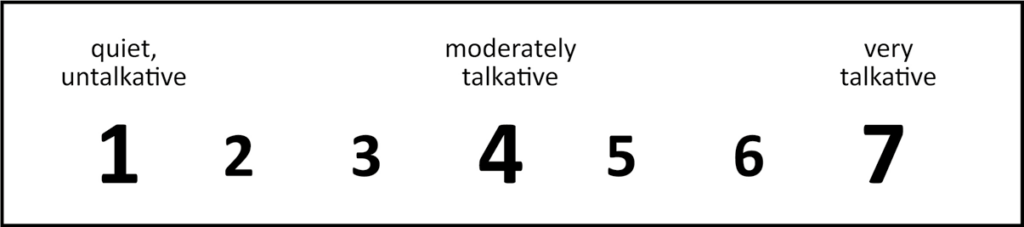
The scale is meant to address personality, not job — though there is a very high correlation between job selection and talkativeness. It is hard to be happy as a midnight watchman if you are a 7. Most people who are a 7 find great intrinsic rewards participating in occupations such as acting, singing, performing, teaching, preaching, or perhaps just finding a stage to be on. We often, but not always, seek out a job that matches our psychological desire for our degree of innate talkativeness.
This scale is accurate enough that when I reviewed patient charts during my fellowship, I found no patients who had rated themselves a 4 or lower who had vocal cord swellings from overuse.
On a review, no patients who had rated themselves 4 or lower on the talkativeness scale had vocal cord swellings from overuse.
Innate Vocal Loudness
I use the same 7-point scale for innate vocal loudness. 1 is a soft-spoken person, 4 is a person with moderate volume, and 7 is a person whose voice always projects well. Volume also has some predictive value for vocal swellings, though not quite as strongly as talkativeness.
Mrs. Chatterly might have been oblivious to her voice fading away, but if her voice didn't return soon, I bet she sought treatment. For a 7, a functioning voice is too valuable to do without for long.
What You Learned
- Talkativeness is innate, not a habit — it is a fixed personality trait. The 7-point Bastian scale measures this accurately; most patients self-rate between 3 and 7.
- Quantity of vibration is the primary risk factor — overuse leads to swelling at the mid-membranous cord edge where impact forces are highest, eventually forming a callus.
- No patient scoring 4 or below had overuse swellings — the Bastian scale has real predictive value, confirmed in fellowship chart review.
- Loudness compounds the risk — high talkativeness combined with high innate loudness creates the greatest cumulative impact load on the vocal cord edge.
- Interrupt talkative patients — passive listening is perceived as coldness and inattention; active interruption is perceived as genuine interest and engagement.
Research
The clinical observations in this chapter are supported by a peer-reviewed study of 974 patients:
Bastian RW, Thomas JP. Do Talkativeness and Vocal Loudness Correlate With Laryngeal Pathology? A Study of the Vocal Overdoer/Underdoer Continuum. Journal of Voice. 2016;30(5):557–562.
Key finding: High talkativeness and loudness correlates strongly with mucosal disorders (nodules, polyps, capillary ectasia, hemorrhage). No patient rating themselves 4 or lower on the talkativeness scale had vocal cord swellings from overuse. Lower talkativeness correlates with muscle deconditioning disorders such as vocal fold atrophy and presbyphonia.