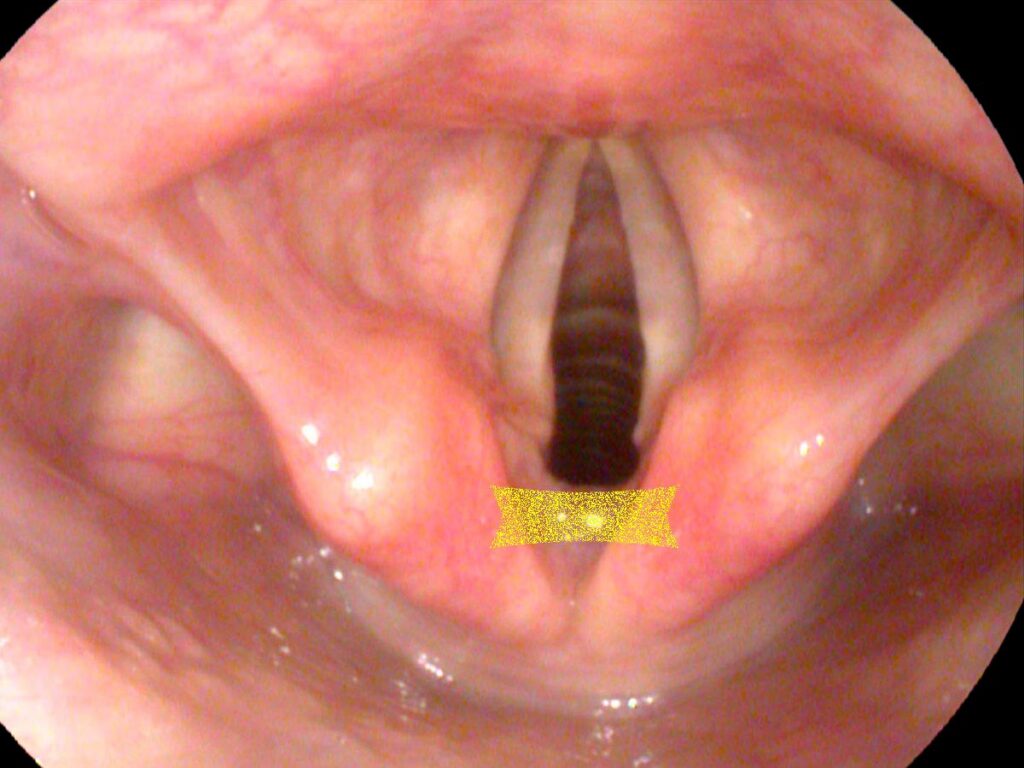
The IA muscle holds the vocal cords in a closed position after the LCA muscles bring them together. Uniquely among the laryngeal muscles, it may receive nerve input from both sides of the larynx.
The InterArytenoid (IA) Muscle
The IA muscle holds the vocal cords in a closed position after the LCA muscles bring them together. The IA muscle from one side attaches with the IA muscle from the other side.
Even in complete unilateral paralysis, the IA muscle on the injured side may still contract — because it receives nerve input from the opposite side.
Because the IA muscles connect in the midline, this is one muscle where there seems to be cross innervation or nerve input from the opposite side. So even when there is complete paralysis of one side of the larynx, the IA muscle on the injured side may still function because of this cross innervation. In this situation, on endoscopy we may see a twitch of the arytenoid of an otherwise apparently completely paralyzed vocal cord due to innervation from the opposite IA muscle.
What You Learned
- The IA holds the cords closed — it maintains adduction after the LCA muscles bring the vocal cords to the midline.
- Cross innervation is unique to this muscle — the IA may receive nerve input from the opposite side, unlike any other laryngeal muscle.
- A twitch can reveal partial function — a visible arytenoid twitch in an otherwise paralyzed cord may signal intact cross innervation from the contralateral IA.