At this point in the exam — after the medical history and the vocal capabilities — the laryngologist should already be able to predict what he is going to find. Laryngoscopy is the key that reveals what is behind the door.
Types of Endoscopes
The word laryngoscopy breaks down simply: laryngo — the larynx or voice box, and scopy — to look at. The essence of laryngoscopy is getting a light to the larynx. Remember that a light in the hand and a tongue blade are not enough to see the vocal cords, although laryngoscopy can be as simple as putting a mirror in the back of the throat and shining a light on the mirror. The brighter the light, the better the view — but for a detailed laryngeal exam, moving beyond the mirror is essential.
Technology has come a long way in the short space of my medical career. Glass rods, flexible fibers, flashing strobes and video microchips on the tips of flexible tubes have opened up a bright new world for the examiner.
Essential Equipment — Standard Voice Lab
- Rigid endoscope coupled to a camera
- Flexible fiberoptic endoscope coupled to a camera
- Light source
- Recording device — computer with adequate memory for video recordings
- Stroboscope
As one can afford more, the ideal upgrades include: a flexible videochip endoscope, a flexible high-definition videochip endoscope, a transoral rigid endoscope attached to a high-definition camera, a videochip endoscope with a working channel, a stroboscope, a digital recording device, and two high-definition video screens — one for the patient to watch and one behind the patient for the examiner to watch during the exam.
I would give up a rigid endoscope and a stroboscope before giving up a video recorder in the voice lab. Without a recording, viewing the larynx with only the naked eye loses too much value in the way of documentation and review.
The Recording Device
Recording video for voice evaluation is a must. There is far too much anatomy in the larynx to see it all at once. There is far too much movement in the vocal cords — and it happens too rapidly for the naked eye to see and process all of it. Only with a recording can the examiner review the structure and motion repeatedly and in slow motion in order to identify pathology.
The human eye is a notoriously poor recording device. Our memory quickly forgets important findings. We completely ignore things that we see when we feel they’re not important — and later they might be the most important finding. Consequently a camera is the most valuable device after having any one endoscope. I will add that recording audio along with the video is also essential: the pitch affects laryngeal configuration, and matching visual findings with audible findings is essential.
Rigid Endoscopy
I prefer the 70-degree Hopkins rod glass endoscope. The 70-degree endoscope can be placed closer to the larynx than the 90-degree while maintaining the entire length of the cords in view. Either rigid endoscope offers superb clarity of view. The rigid endoscope is poor at assessing much function other than changes along the medial margin of the vocal cords because it is limited to a single perspective that is nearly directly above the larynx.
In the high-end lab, I use the rigid endoscope primarily in the patient where I suspect there is a mucosal lesion — otherwise I use the flexible chip endoscope on nearly every exam. The rigid endoscope gives a fairly detailed view of the microvasculature as well. The images are beautiful for presentations.
Flexible Fiberoptic Endoscopy
There are many flexible fiberoptic endoscopes that are relatively affordable by medical standards. Their flexibility allows a varied functional view of the larynx and when brought close to the vocal cords, a varied perspective which is underutilized by many laryngologists. However, detail is lost because of the fibers transmitting the image — the moiré effect from pixilation by the optic fibers creates a soft-focus appearance. Even with a less-than-clear image, the key for the laryngologist is to move the endoscope beyond the nasopharynx and get close to the glottis. Closeness improves the image.
Flexible Chip Endoscopy
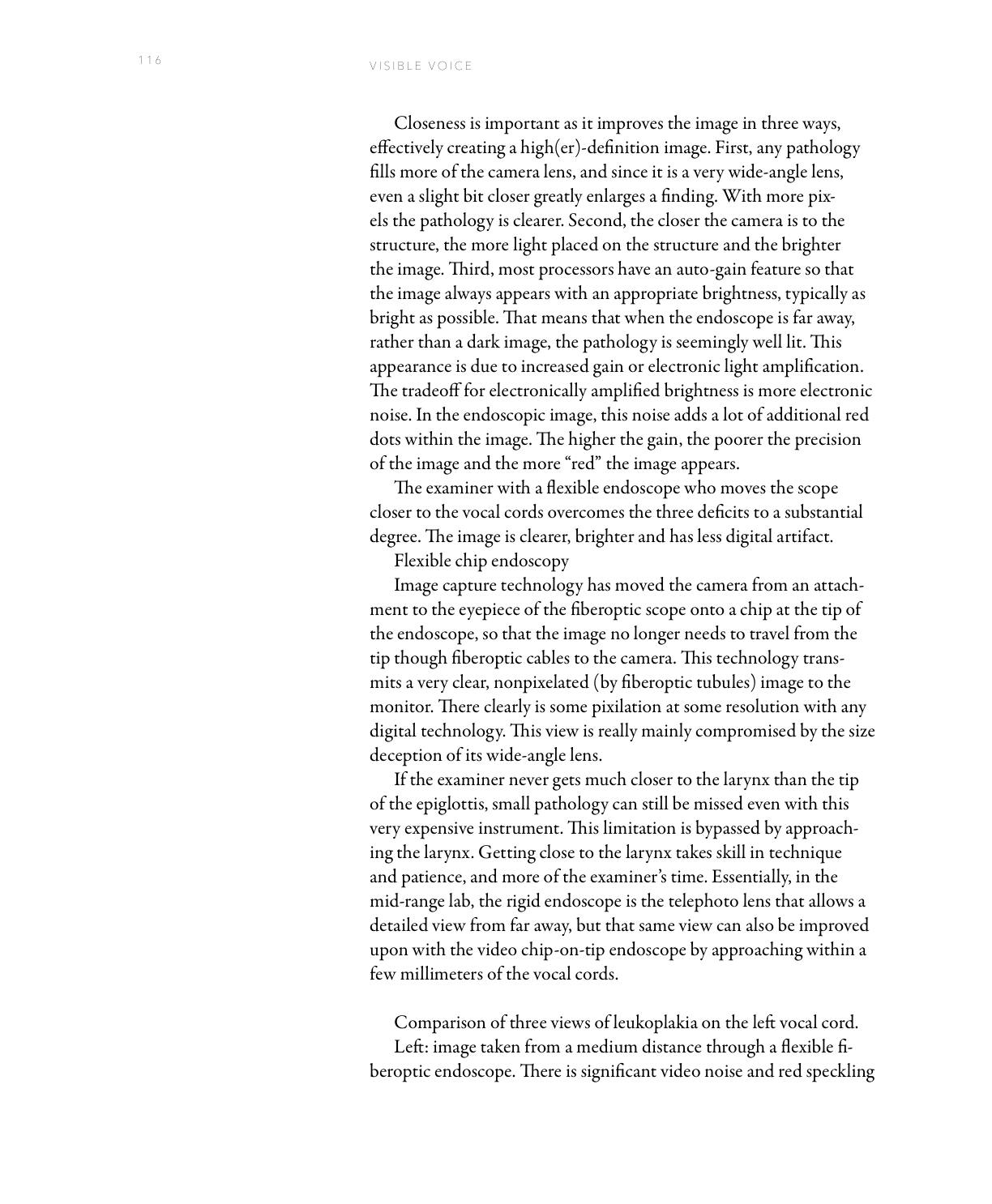
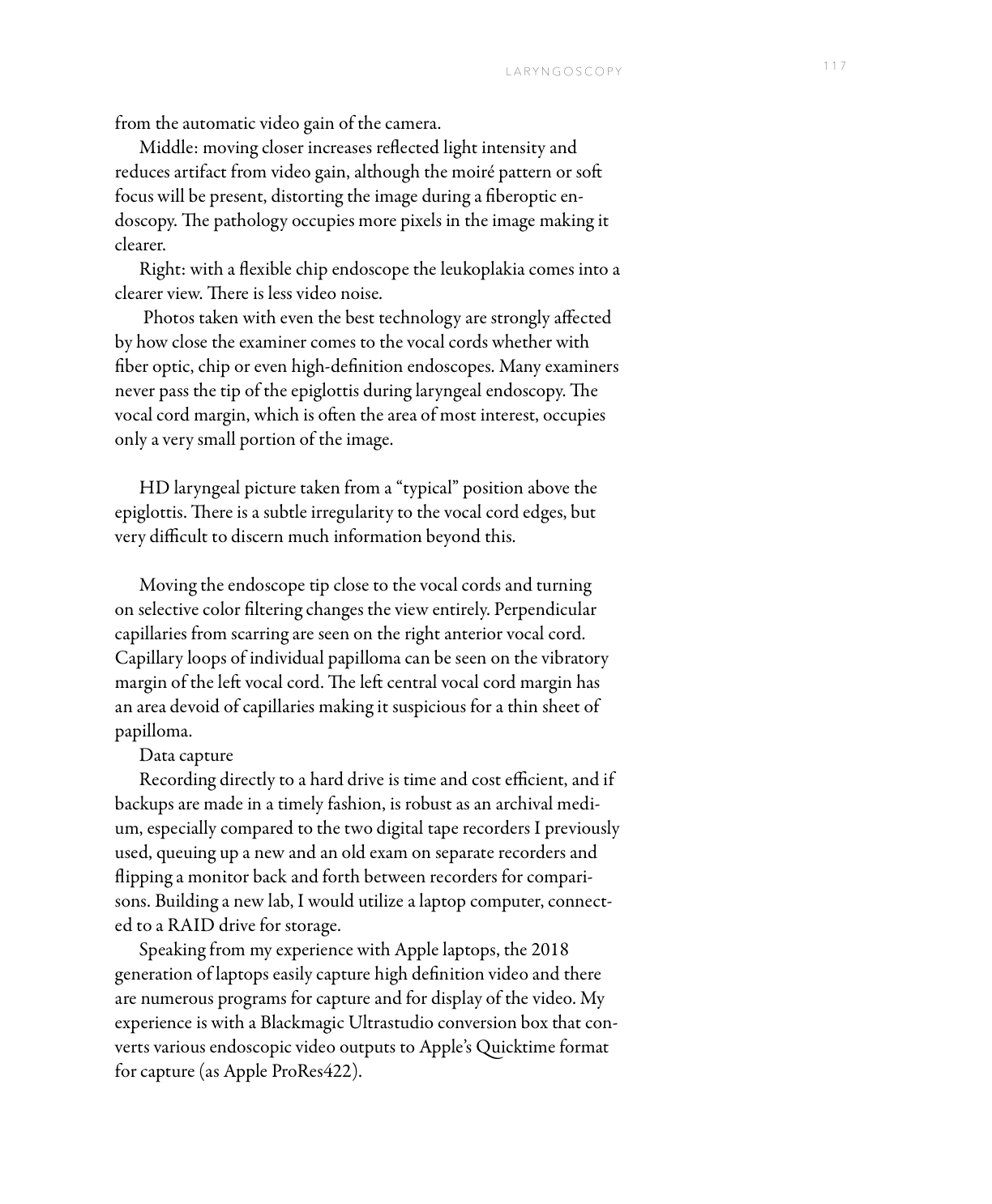
Image capture technology has moved the camera from an attachment to the eyepiece of the fiberoptic scope onto a chip at the tip of the endoscope, so that the image no longer needs to travel from the tip through fiberoptic cables to the camera. This transmits a very clear, non-pixelated image to the monitor. If the examiner never gets much closer to the larynx than the tip of the epiglottis, small pathology can still be missed even with this very expensive instrument. This limitation is bypassed by approaching the larynx. Getting close takes skill in technique and patience — and more of the examiner’s time.
The Stroboscope
A stroboscope detects the pitch of the voice, then flashes a shutter at a rate slightly offset from the pitch of the voice. This slightly lower or higher rate of speed records an image creating the illusion of slow motion. With the assumption that the vocal cords are vibrating regularly, the recorded image represents the actual motion of the vocal cords, which otherwise cannot be perceived.
Typical NTSC video records images at about 29 frames per second. A male speaking vibrates the vocal cords about 100 times per second. Thus, in the case of a constant light source, the edges of the vocal folds move through three complete cycles for every video frame — and consequently appear blurred. The stroboscope’s offset flash rate creates an apparent slow-motion view of what is otherwise invisible.
My Typical Exam
In a new patient, I typically record the vocal cords for about four minutes — ranging from three to nine minutes depending on how easy or difficult it is to find and define the problem. During the endoscopy, I observe in sequence: closure and function of the soft palate (cranial nerve IX/X function), diameter of the nasopharynx, pharyngeal squeeze during attempted high pitch (cranial nerve X — pharyngeal branch), base of tongue, epiglottis, esophageal inlet and posterior larynx, passive respiration, false cords, interarytenoid area, vocal cords at close view, and laryngeal ventricles — then I switch to strobe light and assess phonation at comfortable pitch, lowest pitch, high pitch, gliding up and down in pitch, and any combinations of pitch and volume that elicit gaps and asymmetries.
My typical duration for an office visit with a new patient is 45 to 60 minutes including taking the history, performing vocal capabilities testing, the endoscopy, and then the time spent discussing the findings with the patient. I often continue reviewing the video’s different parts in slow motion after the patient leaves — I find that I continue to teach myself by critically reviewing each endoscopy.
I use endoscopy to confirm or disprove what my ears tell me should be the problem. When the three-part exam — history, vocal capabilities, and endoscopy — all point to the same finding, the diagnosis is assured.
What You Learned
- The recording device is more valuable than the scope — without video, the human eye misses the speed and subtlety of vocal cord motion.
- Closeness is the highest-yield technique upgrade — approaching the vocal cords increases magnification, brightness, and effective resolution regardless of equipment tier.
- The rigid scope gives the best view of the mucosal edge — its perpendicular overhead perspective highlights marginal swellings against the dark background of the trachea.
- The stroboscope reveals what continuous light hides — by flashing at a rate slightly offset from the vibration frequency, it creates the illusion of slow motion.
- A complete exam takes 45–60 minutes with a new patient — anything shorter is likely a “snapshot” rather than a defining look at how the vocal cords actually function.