
Voice is sound. Sound production is based on physics. All vocal impairments occur because of a physical change in vibration. Any time hoarseness is described without reference to physics, the explanation has a high probability of being incorrect.
The Vibratory Cycle
In the idealized situation, here is how sound is made, step by step:
- The back of the vocal cords leave the breathing position, moving together until nearly parallel; tension is simultaneously applied as they narrow the airway.
- Air is propelled through them from below, accelerating and creating the Bernoulli effect — the mucosa draws inward.
- Viewed from above, the cords start opening at the top edge — the upper lip.
- As the upper lip opens, the lower lip starts closing.
- The puff of air just released travels like a wave outward over the surface of the vocal cords.
- The lower lip closes, then the upper lip closes.
- A new puff of air opens the lower lip again — and the cycle repeats.
These steps repeat over and over, creating pulses of air — vibration.
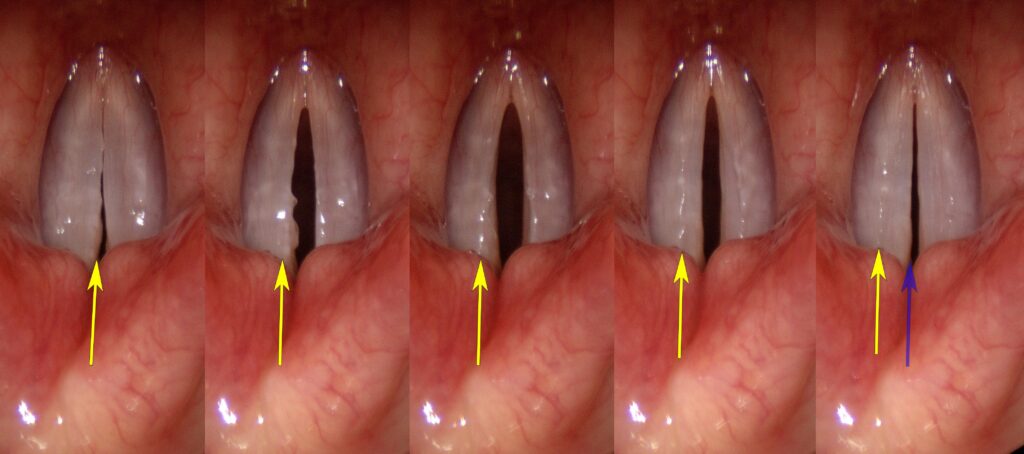
The upper and lower lip concept matters clinically. The central portion of the membranous vocal cord moves through the greatest range, so problems develop where impact forces are greatest. Swellings can wrap around both lips, or a polyp may exist only on the upper or lower lip. A lower-lip lesion may be hidden half the time during vibration — requiring stroboscopy reviewed frame by frame to detect it.
Characteristics of a Normal Voice
The vocal cords oscillate rapidly — perhaps 100 to 200 times per second during casual speaking, with smaller cords tending toward faster oscillation. In a set of near-perfect cords at a comfortable speaking pitch, they:
- Are open about half the time and closed about half the time
- Let air out in measured puffs
- Do not leak air during the closed phase
- Vibrate regularly
- Vibrate symmetrically
This oscillation creates the sound we hear. Any single note can be visualized on an oscilloscope as a sine wave — a regular vibration. When we hear it, we hear a musical tone.
Measuring Pitch
We can talk about pitch in terms of frequency, measured in Hertz (Hz) — vibrations per second. However, the Hertz scale is logarithmic and not easily added or subtracted. The distance of one semitone between C3 (130.81 Hz) and C3# (138.59 Hz) is 7.78 Hz, while the same melodic interval between C4 (261.63 Hz) and C4# (277.18 Hz) is 15.55 Hz. The notes sound equally spaced to our ears, but the Hz numbers are not evenly distributed.
An alternative is the musical chromatic scale — 12 equally spaced pitches per octave — which labels each tone produced (C3, C3#, D3, D3#, and so on). Each succeeding note is one semitone higher than the previous. I use this “semitone method” for documenting the voice, since the visual distribution of piano keys separates sounds into audibly equal intervals without requiring logarithmic calculation. Middle C on the piano is C4; one octave lower is C3. The semitone method is simpler and clinically sufficient.
Voice is sound. Sound production is based on physics. All vocal impairments occur because of a physical change in vibration.