
Paul’s grandson, John Bunyan, was working in his orchard when a log fell on his chest and neck. He arrived at the emergency room in a coma, where they placed a tracheostomy tube into his trachea to breathe for him. A fracture of his larynx was repaired, but when he woke, he had no voice at all. The first surgery was revised with a new plate on his thyroid cartilage and after this, some voice returned. Six months later, when he visits me, his voice is still lower in pitch, rougher in quality and softer in volume than it used to be.
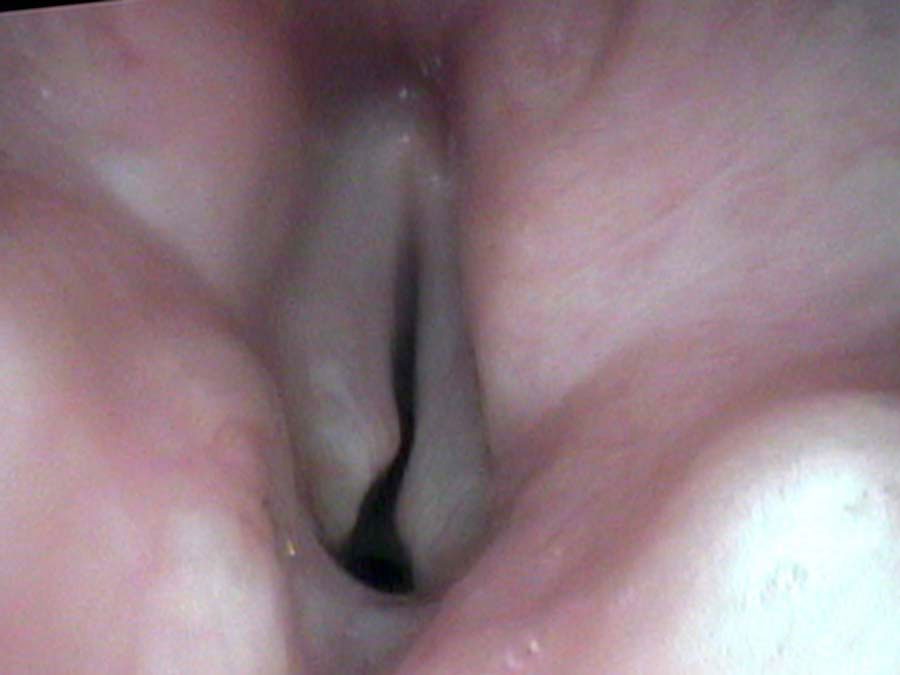
The left vocal cord is shorter and has less tension than the right. This loosening of his left vocal cord — and possibly his right to a lesser extent — can explain all of his symptoms. With loose vocal cords, they will vibrate at a lower pitch than before the accident. With the left vocal cord shorter and looser than the right, he has a double pitch and he also leaks air between the gap in his cords. So he has both a rough and a husky hoarseness. He cannot hold enough air below his cords to get as loud as he used to when he tries to yell.
With loose vocal cords, they will vibrate at a lower pitch than before the accident. With the left vocal cord shorter and looser than the right, he has a double pitch and also leaks air between the gap — both a rough and a husky hoarseness.
With another surgery, I removed the plate and cut and lengthened his left thyroid cartilage. This stretched the left vocal cord. Though he was not all the way back to his pre-injury voice, his voice was stronger, smoother and higher pitched after this surgery.
What you learned
- Blunt trauma to the neck can fracture the thyroid cartilage, shortening one vocal cord and reducing its tension relative to the other — causing both rough hoarseness (diplophonia from asymmetric pitch) and husky hoarseness (air leak from incomplete closure).
- The position of the vocal processes relative to each other on endoscopy is a reliable indicator of asymmetric cord length and tension after laryngeal trauma.
- Surgical lengthening of the shortened thyroid cartilage stretches the slack vocal cord back toward its correct tension — improving pitch, volume, and voice quality without removing tissue.
- Even after repair, the voice may not return fully to its pre-injury baseline — but significant functional improvement is achievable with careful surgical planning.