
“Doctor, the more I sing, the more I have to clear my throat.” I often see patients with sticky mucus, perhaps more often than I see patients with thin, translucent mucus. Sticky mucus clearly can alter vocal cord vibrations. However, I hear many people claim they drink copious amounts of water, yet still they have sticky mucus. Many people describe a sensation of a copious amount of post-nasal drip leading to throat clearing.
There are two types of salivary glands in the throat: serous and mucous. The serous glands produce secretions that are very watery. The mucous glands produce secretions that have a high concentration of proteins that makes mucus, which is much stickier than water. Perhaps there is some genetic predisposition to have thick or thin mucous. Maybe there is even some optimal ratio of the two types of secretions. Both types of secretions likely have roles to play. The thin secretions seem to lubricate the lining while the proteins from the mucous glands might keep the mucus adherent to the lining.
Personally, I notice that my vocal cord secretions are thicker and sticker after drinking an espresso. Diuretics, whether in the form of caffeine, alcohol or a pill (such as furosemide which people take for blood pressure) lead to stickier mucus on the vocal cords. There are also drugs which seem to have an impact on the consistency of secretions. Guaifenesin is one of the most common drugs used as an expectorant, a mucous stimulant and thinner. You can find it in many cold medications. Anti-reflux medication also seems to thin mucous out, at least in some people, perhaps increasing the ratio of serous to mucinous secretions.
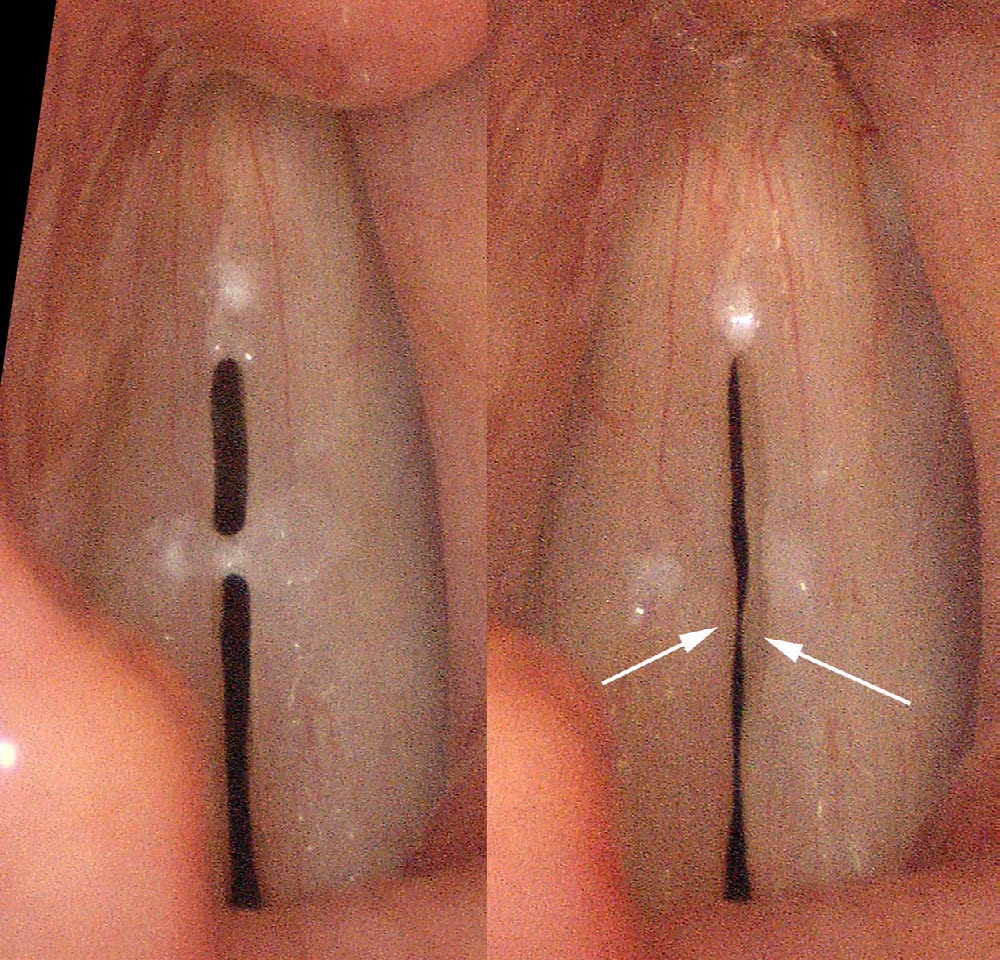
For the dedicated examiner, secretions quite often act as a divining rod, pointing to where a lesion will be found, rather than hiding it.
More commonly than actual thick mucus, I find that secretions tend to accumulate anywhere on the vocal cords where vibrations are impaired. For example, a person with a polyp, nodule or other swelling will tend to accumulate mucus on the polyp while they are making sound and have to constantly clear it off the vocal cords. People with weak, thin or bowed vocal cords will tend to have secretion accumulation at the ends of the vocal cords where they come together. If the impairment of vibration is corrected, fewer secretions will accumulate.
What you learned
- Sticky mucus is produced by mucous glands (high protein concentration), while watery secretions come from serous glands — the balance between the two determines mucus consistency.
- Diuretics — including caffeine, alcohol, and blood-pressure medications — reduce hydration of the vocal cord surface and lead to thicker, stickier secretions.
- Guaifenesin (found in many cold medications) and anti-reflux medications can thin secretions and reduce throat-clearing in some patients.
- Thick mucus is often a sign of a lesion rather than the primary problem: secretions accumulate where cord vibration is already impaired, pointing the examiner toward the underlying disorder.