
When there is no structural problem and “behavior” is the problem, this vocal impairment results from vocal technique issues that start for a variety of reasons. I call this category nonorganic and place it in the behavioral hoarseness category because the mucosa is normal, the muscles are normal, all the structures are normal. The pattern of use of the vocal cords is the problem. This is the category where terms are most variable in my profession.
Competitive Muscles
Maria Cantata is 18 and just started her professional voice studies at university. She began struggling with her voice and her new vocal professor suggested that she have her vocal cords examined before he pushes her too much. Maybe she has, God forbid, nodes! She has five years of formal vocal training and her goal is to become a professional opera singer. During her last year of high school she sang with a pop band on some weekends. Now she is only pursuing classical musical training.
During our exam, I ask Maria to sing, going from a low note to her highest possible note. As she performs the task, ascending the scale, she sings louder and louder. Clearly she has a broad vocal range in terms of pitch. I ask her to repeat this vocal task again, but with the softest possible sound she can make for all the notes. She performs fine throughout her low range, but as she reaches her mid to upper range her voice starts cutting out and she becomes flustered.
“I haven’t had a chance to warm up,” she apologizes.
For diagnostic reasons, I am not interested in her warmed-up voice, nor in her loud, robust voice. I ask her to start again at a slightly lower pitch and move up the scale, but she must not increase her volume. On a slightly different note, her voice begins to cut out.
What Is Happening?
I place my fingers on the top of her larynx as she sings. The muscles holding her larynx in place in the neck tighten. I feel her thyroid cartilage pull fairly strongly upwards in her neck during phonation. This excess tension causes the discomfort with vocal use, especially singing.
I record video of Maria’s vocal cords at the pitches where she is struggling, noting that the back of the vocal cords are not together. Actually, when I slow the recording down, I see the vocal cords come together initially and then pull slightly apart as actual sound production begins. The LCA muscle brings her vocal cords together, but moments later she tightens her PCA muscle and this pulls the vocal cords slightly apart at the rear. At very slow speeds, I can show Maria this muscle bulging as it contracts.
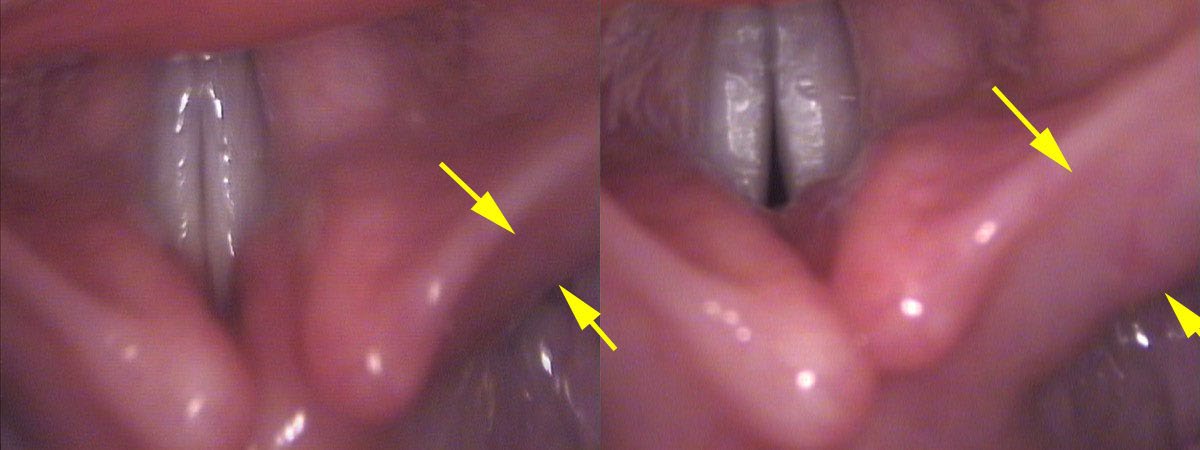
When the vocal cords are held apart, air leaks between them. By asking Maria to sing at her softest pitch, the air preferentially leaks out through the gap, as a whisper, rather than starting up the vocal cord vibrations that we would hear as a note. The posterior gap between the vocal cords is variable depending on her effort and thus the vocal impairment is variable. That is why her voice starts cutting out on different pitches each time we test her singing up the scale.
Maria innately knows from practice that if she warms up, she can produce a sound from the very first attempt. Effectively after warming up, she builds up a muscle memory — a vocal cord position with a sufficient force of air beneath her vocal cords, that when released suddenly, as a blast of air, the vocal cords jump-start into vibrating. But she cannot get them started up with a soft, gentle onset. There is not enough air pressure to start the vibrations when the air can leak out through a gap more easily. Warming up in this case is the development of compensation for her problem. Since we are both in the office to find the problem with her voice, warming up is not helpful diagnostically.
Tension is the cause of Maria’s air leak and discomfort. Relaxation of her larynx during singing will restore a normal voice.
Style, Mimicry, and Correction
In all likelihood, Maria trained herself to sing in a style with the vocal cords slightly apart, and that style was fine for her pop band. It just does not work for some of the classical operatic arias she is now attempting. Without going into all the inferences about what this means for training and how to correct the problem, we can at least identify the problem as an air leak. It has the quality of a husky hoarseness. If, at some time in the future, Maria learns to close her vocal cords completely while singing, her hoarseness or vocal impairment will resolve. Most likely this will require further work with her vocal coach. She will then be able to sing both softly and loudly at all the pitches available to her, within her vocal range.
Young singers often try to mimic a certain style or individual and in doing so often tighten the laryngeal muscles in an unusual way to achieve the sound they desire. One of the problems with mimicking something one hears is that one hears her own voice via sound conduction through the bones in her head, which is different than how others hear you. Thus, the reason no one ever likes hearing a recording of their own voice — it is not them.
Usually directing a person’s attention away from a particular sound quality and focusing on making each note clearly, no matter the character, yields the cleanest singing result. It can take time to correct this problem, as the muscle memory from singing a particular way for a prolonged period can be quite strong.
What You Learned
- Muscle tension dysphonia involves competitive activation of the LCA (which closes the cords) and the PCA (which opens them) — the cords close but are held slightly apart, creating an air leak heard as husky hoarseness.
- The impairment is variable: the posterior gap changes with effort, so the voice cuts out on different pitches in repeated attempts.
- Warming up is compensation, not a cure — it builds muscle memory that bypasses the problem but masks it during examination.
- Young singers who mimic a particular style may inadvertently train the larynx into tension patterns that work for one genre but not another.
- Treatment focuses on relaxation of the larynx and redirecting attention to clarity of each note rather than pursuit of a specific sound quality.