
When one vocal cord is structurally longer than the other, the two cords do not align at the midline and tend to vibrate at different pitches. This produces both air leak and roughness — a combined husky and rough hoarseness.
Asymmetric Length
Samantha became critically ill and required multiple emergency intubations. Each time the breathing tube was removed, she deteriorated and required reintubation. When she finally left the hospital she found she wasn’t quite back to normal. Her voice was rough and weak, she ran out of breath easily, and she gasped when trying to speak.
With this history, several possibilities arise: a torn cord, ulceration and scarring from the tube lying between the cords, or injury to the anterior branch of the recurrent laryngeal nerve from the endotracheal tube cuff. On endoscopy, the vocal cords do not completely come together. The left cord is also longer than the right, so they do not line up well when they do come together. Her two cords are different lengths, which will tend to vibrate at different pitches — explaining the roughness. The gap explains the softness.
A length difference between the vocal cords is one of the few asymmetries that cannot be corrected by adjusting tension — it is a structural mismatch that tends to produce both air leak and roughness together.
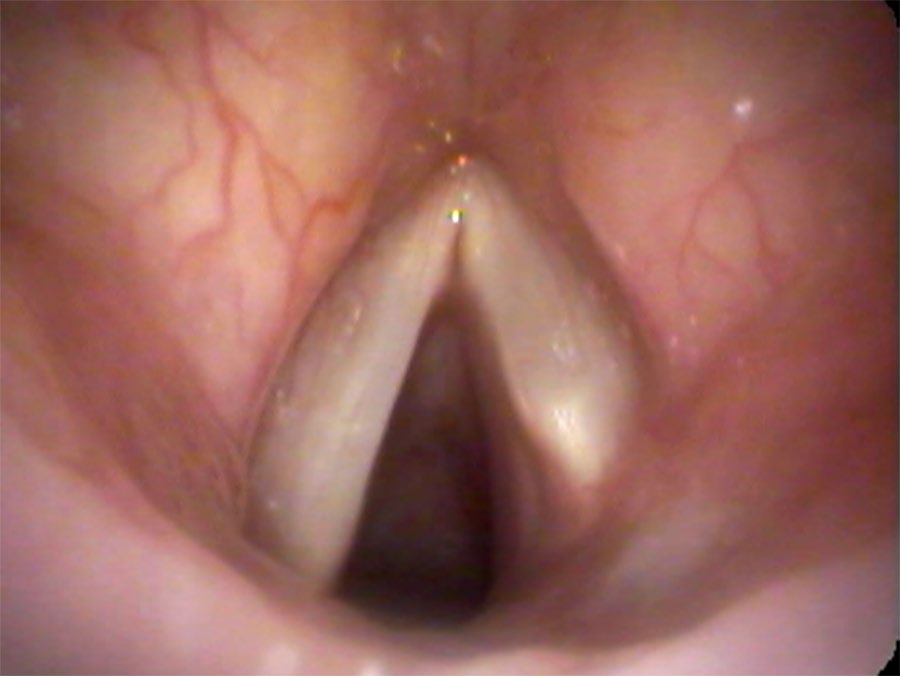
There is no known method of correcting this type of length difference. However, placing an implant into the shorter vocal cord can push it closer to the midline, reducing the air leak and softness even if the length discrepancy and roughness remain.
What You Learned
- Length asymmetry creates a dual hoarseness — a longer cord produces a gap (huskiness) and a pitch mismatch (roughness) at the same time.
- Intubation injury is an underrecognized cause — multiple or urgent intubations can tear, scar, or injure the recurrent laryngeal nerve, altering cord length or tension.
- Medialization implant can reduce the air leak — pushing the shorter cord to the midline improves closure even when the length difference cannot be corrected.